AI automation for engineering firms works best on the paper around the design, not the design itself. A structural, civil or MEP engineer is paid for judgment. Yet a project manager can spend a whole afternoon finding which submittal came back, which RFI is still open and whether a subconsultant’s invoice matches the scope.
We build small AI tools and internal tools for that paper. A licensed person approves anything that leaves the building.
Start with construction administration
Design phases are quiet compared with construction. Once a contractor is building, questions arrive daily, each with a clock on it. A late answer is a contractor standing idle, and the contractor remembers.
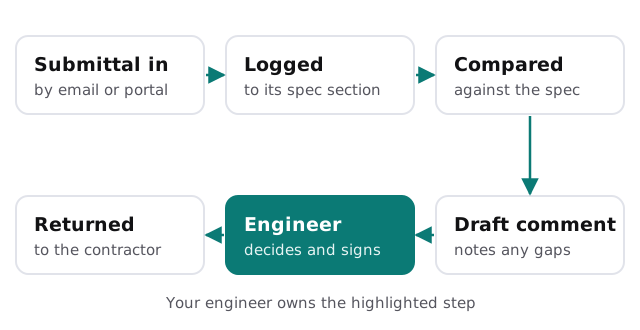
The tool reads the incoming submittal, logs it against the right spec section and notes what the section asks for: product data, samples, certifications. It then drafts a comment listing what looks missing or different. The engineer opens the draft next to the submittal, edits it and decides.
Four tasks, four owners
| Task | Who decides | What the tool prepares |
|---|---|---|
| Submittal review | Reviewing engineer | A checklist against the spec and a draft comment |
| RFI response | Engineer of record | The relevant drawing sheets and spec text, plus a draft reply |
| Drawing QC | Project engineer | A pre-check list from your own standards |
| Invoice review | Project manager | Percent complete against budget, and line items that look off |
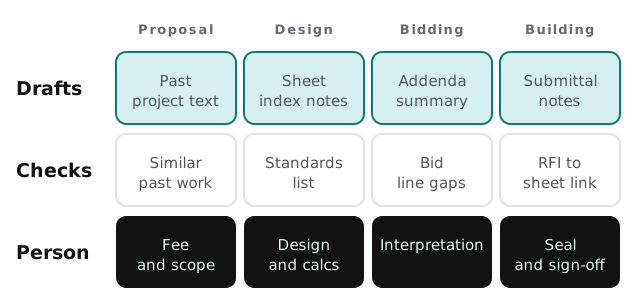
Notice that the tool never owns a row. That is deliberate. The seal and the signature are a person’s, and the tool should make that person’s review faster, not replace it.
The week, per role
- Principal. Proposals start from a real draft assembled from your past statements of qualifications, with the right project sheets pulled in.
- Project manager. One summary of open items per project on Monday, and fewer calls asking “where are we on this?”
- Project engineer. Standards checklists run before a set goes to review.
- Drafter or technician. Sheet index and revision notes drafted from the change list.
- Admin. Timesheet reminders sent on Thursday, not discovered on the first of the month.
A Thursday on a school renovation
A contractor emails a roofing submittal at 8am. By 8:15 it’s logged to the right spec section, with a note that the manufacturer’s data sheet is attached but the sample isn’t. The project engineer opens the draft comment, agrees with one point, rewrites another and returns it before lunch. Nobody searched an inbox, and the contractor never had to ask where it was.
Utilization and the Friday timesheet
Engineering firms live on billable hours by project and task. When time is entered late, the month-end invoice becomes a reconstruction. A simple tool can check entries against the schedule and calendar, then nudge people about the gaps. It reports; it does not edit anyone’s hours.
The software around the firm
- Design tools. CAD, BIM and analysis software. We leave them alone.
- Project accounting. Budgets, timesheets, invoicing and subconsultant tracking. A tool reads these and flags mismatches.
- Document management. Where drawings, calculations and correspondence live. Search across it is a common first request.
- Email. Where most RFIs and submittals actually arrive, and where the log falls behind.
If you’d rather connect two of these yourself, setting up Zapier for your team walks through a simple version.
Questions for any provider
- Does the tool ever write into our records, or only draft beside them?
- Can it show which spec section or sheet each suggestion came from?
- What happens when it can’t find the answer in our documents?
- Can a reviewer see exactly what was changed before they sign?
What we need from you
Your current submittal and RFI log, a sample spec section, your QC checklist and the one log you trust least. We return a plan and a fixed quote after the free IT check. A real person replies within 1 business hour, Monday to Friday, 9am to 5pm Pacific.
A seal means a licensed person looked. Build tools that make that look faster and better informed, never optional.