AI automation for trucking companies matters most in the office, not the cab. A truck earns when it moves, and it gets paid only when the paperwork arrives. Everything between those two events, from the rate confirmation to the proof of delivery to the invoice, is work a small team does by hand. We build small AI tools and internal tools for that work, and for the fleet logistics around it, with a dispatcher or an office person approving anything that goes out.
Paperwork is the cash cycle
- The rate confirmation arrives by email, usually as a PDF, and the load is entered into your system.
- The driver picks up and sends a photo of the signed bill of lading.
- The driver delivers and sends the proof of delivery, often a photo taken in poor light.
- The office assembles the packet: confirmation, bill of lading, delivery proof, any detention or lumper receipt.
- The invoice goes out, and a factoring company or the customer pays.
A tool can read each document as it arrives, match it to the load, check it against the rate confirmation and list what is missing. When a proof of delivery is unreadable, it drafts a text asking the driver to retake it. Invoices go out the day the packet is complete rather than when someone gets to them.
Hours of service, read not managed
Federal rules limit how long a driver can work. For property-carrying drivers, the regulation sets a 14-hour window after coming on duty, a limit of 11 hours of driving inside it and a 30-minute break once 8 hours of driving have passed, with weekly limits of 60 hours in 7 days or 70 in 8 days (49 CFR 395.3).
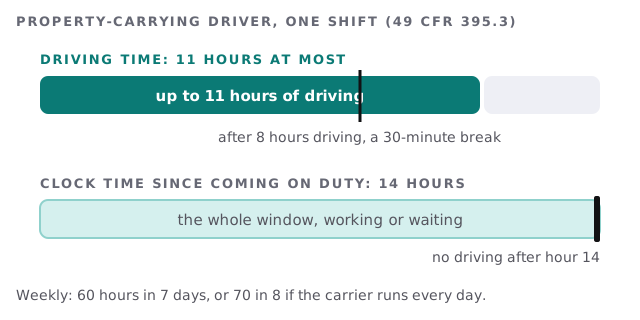
Your logging device is the record. A dispatch tool can read what it reports and show a dispatcher who is likely to have time for a load. It never edits a log or advises a driver to push past a limit, and we do not claim any tool makes a fleet compliant.
The gap on the board
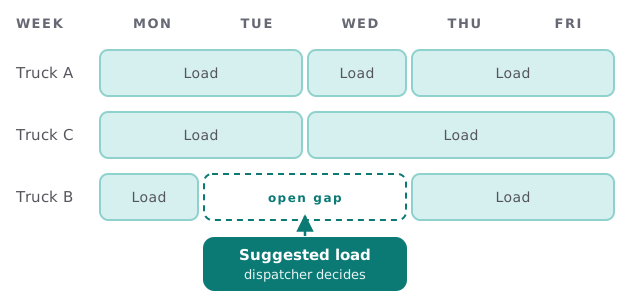
A tool can scan your board for stretches where a truck has no load, then list loads from your own customers, broker emails and load board saves that fit the location and the equipment. The dispatcher looks at the list and decides. For a brokerage, the same scan runs in reverse: it looks for loads without a carrier and carriers without a load.
Driver files and expiry dates
Each driver has a file with a license, a medical card, past employment checks and training records. Many of them expire. A tool can read the file, list every date coming up in the next ninety days and draft a reminder to the driver and the safety manager. Someone still checks the actual document.
Settlement day
If you pay by the mile, by the load or by percentage, a weekly settlement means pulling loads, fuel advances, deductions and escrow into one statement. A tool can build the first draft from your records and flag anything odd, such as a load with no delivery proof or a deduction that does not match. The accountant approves.
Who gets the relief
| Role | What piles up | What a tool prepares |
|---|---|---|
| Dispatcher | Inbox, rate confirmations, board gaps | Load entries, gap list, driver availability |
| Billing clerk | Missing paperwork, invoices | Complete packets and a chase list |
| Safety manager | Expiry dates, files | A date-sorted list and drafted reminders |
| Owner | Settlements, margins per lane | A first-draft settlement and a lane summary |
The software around a fleet
Most fleets run a transportation management or dispatch system, electronic logging devices, a fuel card, a maintenance tool, accounting and sometimes factoring. A brokerage adds load boards and a carrier-vetting service. What each exports determines what we can build, so we map them in the free IT check.
The calendar
Produce seasons, quarter-end pushes and the holiday freight surge all put paperwork behind trucks. Settling a paperwork tool in the slow stretch is a lot easier than learning it during a surge.
What we need from you
A week of anonymized loads with their paperwork, a copy of your settlement sheet and the systems you use. After the free IT check you get a plan and a fixed quote. A real person replies within 1 business hour, Monday to Friday, 9am to 5pm Pacific.
Trucks get paid when the paperwork is right. Anything that shortens the gap between the delivery and the invoice is worth a hard look.