“Agent” is a loose word, so here’s the version that matters to a small business. An agent is a program that takes a request, decides which of a few tools to use, uses it, and looks at the result. It might look up a customer, draft a reply and file a task. AI agent development for small business is the work of choosing those tools carefully and putting a person in the loop where it counts.
What happens in one turn
The mechanism is simple, and it’s why agents can be controlled. According to OpenAI’s developer documentation, the model doesn’t run anything itself. It returns a request naming a function and its arguments; your application runs the function; and the result goes back to the model, which answers or asks for another step.
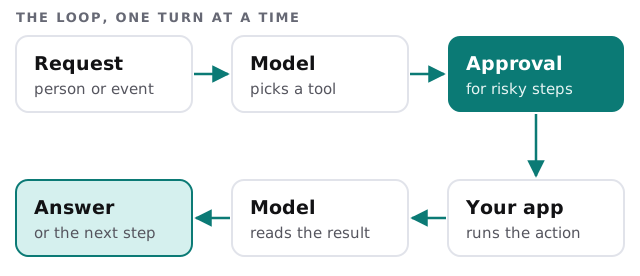
Because your application does the acting, the agent can only do what you’ve built. There’s no tool for “delete the client list” unless somebody writes one.
Chatbot, automation or agent?
| Chatbot | Automation | Agent | |
|---|---|---|---|
| Follows fixed steps | No | Yes | No, it chooses |
| Takes actions | No | Yes | Yes, through tools |
| Handles odd requests | Answers | Often fails | Tries, then asks |
| Best for | Questions | Predictable chores | Jobs with variety |
If the steps never change, a plain automation is cheaper and more predictable. Our page on OpenAI API integration covers the building block underneath, and Claude API integration the alternative. Agents earn their keep when the input varies and a person would otherwise have to read each one.
How much freedom it gets
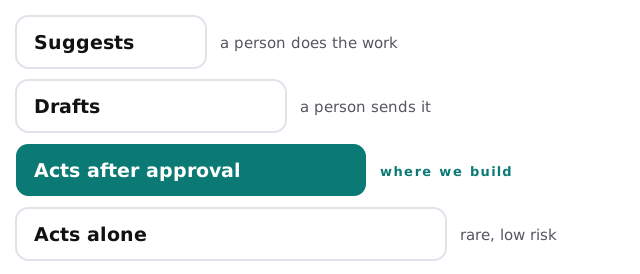
We start agents low on the ladder and move up only when the log shows they’ve earned it.
An example: the enquiry desk
A landscaping firm gets a steady stream of enquiries by form, email and text. An agent reads each, checks it against the price list and the calendar, drafts a reply with a rough range, and puts it in a queue. Someone in the office reads the draft, fixes a word and sends it. Nothing goes out unseen. When the reviewer rewrites the same sentence ten times, we change the instructions so the agent stops making that mistake. This is an illustration of the pattern, not a client result.
Where agents go wrong
The usual failures are dull ones. The agent guesses when it should ask, repeats an action because a step looked like it failed, or reads a document it shouldn’t have been given. Each has a plain fix: make the tool refuse unclear input, make actions safe to repeat, and limit what data each tool can see. We test those cases on purpose before anyone relies on the agent.
What we build in
- Narrow tools. Each action is a separate, named function with limits.
- Approval gates. A person confirms anything that sends, spends or changes data.
- A log. Every tool call is recorded, so you can see what happened.
- A stop switch. One place to turn the agent off.
- Plain failure messages. When it can’t do something, it says so.
What we need from you
- The job in one sentence, with an example of a good result.
- The data it may read, and anything it must never touch.
- The person who approves, named, with a backup.
- A written rule on AI use. Our guide to writing an AI use policy is a starting point.
You get a plan and a fixed quote before we build. For the wider question of where AI fits in your business, see our AI implementation partner page, and for putting a person in the middle of a flow, AI approval workflows.
An agent should be able to do less than a good employee, and prove it every day.