AI automation for churches isn’t about replacing anything sacred. It’s about the Monday morning list: the visitor cards in a pile, the nursery that needs two more volunteers, the bulletin due Thursday. A church staff of one to a few people carries all of that alongside everything pastoral.
We build small AI tools and internal tools around the systems you already use. A staff member approves anything a person in your congregation receives.
The week, in order
- Monday: visitors. Cards filled in on Sunday become records, and each visitor gets a draft thank-you the office can edit and send.
- Tuesday: volunteers. The tool spots empty slots in the next few Sundays and drafts an ask to people who have said yes before.
- Wednesday: events. Sign-ups are tallied, a reminder is drafted for those who haven’t paid or confirmed, and a head count goes to whoever is cooking.
- Thursday: the bulletin. Announcements, the calendar and the service order are assembled into a first draft.
- Friday: slides and run sheets. Lyrics, readings and announcements are placed in last week’s format for the worship leader to correct.
- Sunday: connect cards again. The cycle repeats.
None of it is ministry. All of it is what stands between a pastor and ministry.
Visitors, followed up while they remember you
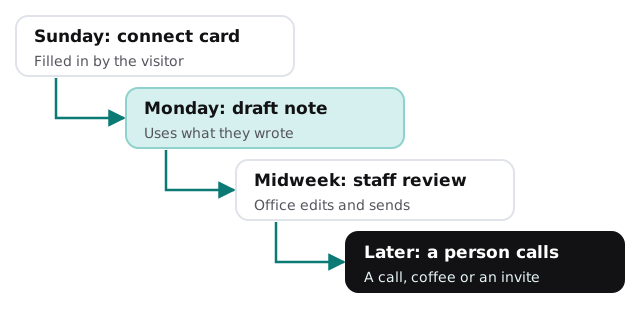
Churches often lose visitors in the gap between Sunday and the first call. The tool reads each card, drafts a short message that mentions what the visitor wrote, such as a child’s age or a question about small groups, and queues it for the office. Someone then reads it, adjusts the tone, and decides who should make the personal contact.
Volunteers without a group-text marathon
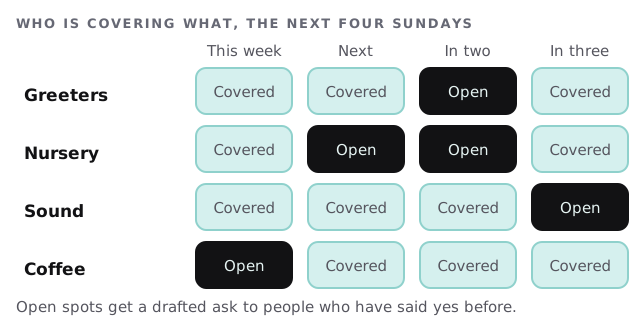
The drafted ask names the role, the date and the person’s past service, and offers a one-line way to say yes or no. Declines are recorded so nobody is asked twice for the same Sunday.
Giving statements and year-end
Year-end is when the treasurer’s workload spikes. A tool can assemble each statement from your giving records, flag records with a missing address or a name that doesn’t match, and prepare the mailing list. The treasurer checks the figures. We never handle money and never touch a donor’s payment details.
The software around a church
| Category | What churches often run | What a tool adds |
|---|---|---|
| Church management | Member directory, groups, attendance | Reads records, prepares lists |
| Online giving | Donation platform | Helps reconcile, never moves funds |
| Service planning | Song and run-sheet software | Drafts the sheet from last week’s |
| Email and text | Newsletter or text tool | Holds drafts for approval |
| Video and sound | Livestream equipment | Out of scope |
We don’t claim to have integrated any product by name. For a simple start, setting up Zapier for your team can send a connect-card form into a spreadsheet and an email.
A Sunday, a week later
A family visited for the first time. By Monday afternoon their card is a record, the draft note mentions the daughter’s age and the kids’ program, and the office has added a line in the pastor’s voice. On Tuesday a volunteer coordinator sees that Sunday’s nursery has one slot open and sends the drafted ask to two names. By Sunday, the family is greeted by someone who knows what they wrote on the card. No one on staff stayed late, and nobody felt processed.
Lines we draw
- Prayer requests, counseling and confessions never go into a tool.
- Nothing reaches a member or a visitor without a staff member reading it.
- Access is limited to the records each task needs, and you can remove it any time.
- A tool never decides who is in or out of anything.
Next step
Tell us which system holds your member records, who handles the office, and which chore is the most hated one. We answer on the free IT check with a plan and a fixed quote. A real person replies within 1 business hour, Monday to Friday, 9am to 5pm Pacific.
A church office should spend its week on people. Software can carry the lists.