AI automation for home health agencies is aimed at the coordination work that surrounds every visit. A caregiver arrives at a client’s home and does the work that matters. Before that, someone received the referral, checked the paperwork, found a person with the right skills who lives close enough, and confirmed the time. After it, someone made sure the note was finished.
That chain is where a small agency’s days disappear.
From referral to first visit
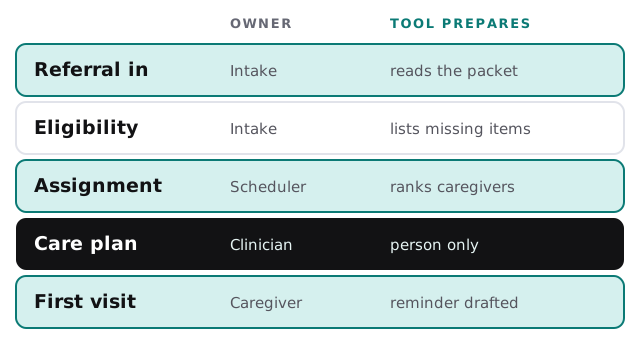
A referral may arrive as a fax-turned-PDF, a portal message or a phone call written on a pad. The first job is turning it into a record: who, what’s needed, when and who to call. A tool can read the packet, fill the intake fields and list what’s missing, such as an unsigned order or an absent contact number. The intake coordinator checks the draft against the source, which is faster than typing it.
Shifts, call-outs and the morning scramble
A caregiver calls out at 6:40am. The scheduler normally works through a list from memory. A tool can rank people who are qualified for that client, available and close, and draft the message to each. The scheduler picks and sends. Nobody is assigned automatically, because matching a client and a caregiver is a human judgment about trust.
Credentials that quietly expire
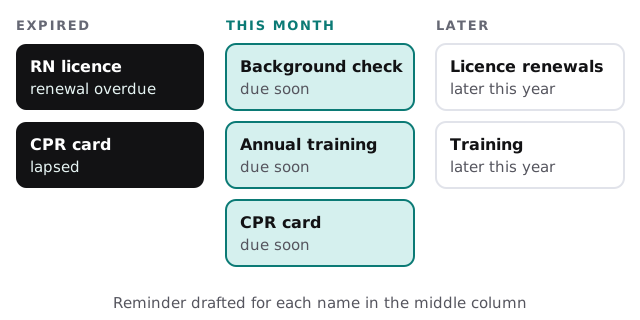
Licenses, training records and background checks each have dates. Missing one can pull a caregiver off the schedule on short notice. A tool reads those dates, sorts them into a short list and drafts the reminder to the person concerned. HR confirms the renewal and updates the record.
A Monday that starts well
By 7am the scheduler has a list: two visits with no caregiver yet, one client whose usual caregiver is out and one training certificate that lapses on Friday. Each item has a drafted message beside it. The scheduler works through them with a coffee instead of discovering each problem at the moment it becomes urgent.
What each person does
| Role | Today | With a tool alongside |
|---|---|---|
| Intake coordinator | Retypes referrals, calls for missing items | Reviews a drafted record and a missing-items list |
| Scheduler | Phones through a list | Reviews a ranked shortlist and sends |
| Clinical manager | Hunts for incomplete notes | Gets a daily list of notes still open |
| Billing | Matches visits to claims by eye | Sees mismatches flagged before submission |
Patient information, plainly
Most home health agencies are covered entities under HIPAA, because they furnish health care and send certain transactions electronically. Under 45 CFR 164.502, a covered entity may share protected information with a business associate only after getting satisfactory assurance, documented in a written contract or other written arrangement. In practice that means an AI service touching patient data needs a proper agreement before it starts. Many useful tasks, such as credential tracking and shift matching, need no patient details at all.
The software around the agency
- Agency management or EMR. Referrals, care plans, notes and billing.
- Scheduling and visit verification. Who goes where, and proof that they did.
- HR and payroll. Credentials, hours and pay.
- Phones and secure messaging. Where many last-minute changes happen.
Questions to ask any provider
- Which fields does the tool read, and can it work without patient names?
- What written agreement do you need from us before it touches patient data?
- Can a coordinator see exactly what it changed?
- How do we remove its access?
What we need from you
Your intake form, a sample referral with the personal details removed, your credential list and the system your scheduler uses. We return a plan and a fixed quote after the free IT check. A real person replies within 1 business hour, Monday to Friday, 9am to 5pm Pacific.
The visit is the care. Everything that gets a caregiver to the right door, prepared and on time, is administration, and tools can help with administration.