AI automation for gyms is mostly about attention. A front desk can’t watch four hundred members. A manager can’t read every cancellation reason. Yet the signal is sitting in your system: who stopped swiping in, who joined a class and never came back, which card failed on the first of the month.
We build small AI tools and internal tools that surface that signal and draft the human reply. Your staff decide what gets said.
Signs it’s time
- You learn a member left when the cancellation form arrives.
- Tour requests sit in an inbox over the weekend.
- Failed payments are chased only when someone remembers.
- Class waitlists exist, but nobody tells the person who’s next.
- January floods the desk and February is a ghost town.
The member who fades
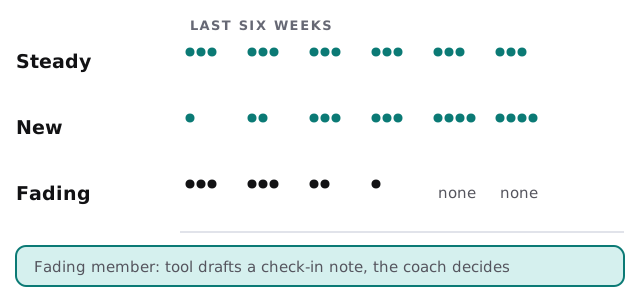
Check-in data tells a story. A tool compares each member’s recent pattern with their own history, not with an average, and lists the people whose habit has changed. For each, it drafts a short note: “We haven’t seen you since the 3rd. Anything we can adjust?” The coach who knows them reviews, tweaks and sends it.
Tours and trials
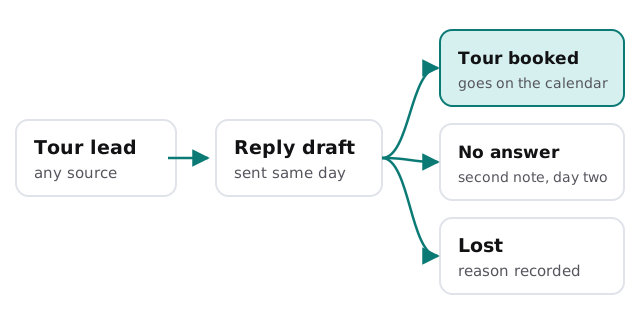
- Capture. A walk-in, web form or social message becomes a record with its source.
- Reply. A drafted message goes out the same day, with the next free class or tour slot.
- Follow up. If there’s no answer, a second note arrives two days later, in your tone.
- Close the loop. Joined, not yet or lost, so you can see which source brings real members.
Billing without awkwardness
Failed payments are a service problem before they are a collections problem. A tool lists failed cards after each billing run and drafts a friendly note with the member’s update link. It keeps freezes and cancellation requests in a separate lane for a person, because those conversations deserve one.
Classes that fill themselves
When a spot opens, the tool messages the first person on the waitlist and moves on to the next if there’s no reply within the time you set. It also notices classes that are always full and times that are always empty, and reports them to whoever builds the schedule.
The software around a gym
| Category | Typical role | What a tool adds |
|---|---|---|
| Membership and billing | Plans, payments, freezes | Failed-card lists, renewal flags |
| Check-in and access | Fobs, app scans, door control | Visit patterns |
| Class booking | Schedules, waitlists | Waitlist nudges, attendance trends |
| Messaging and email | Member communication | Drafts in your voice |
| Website and forms | Lead capture | Replies drafted the same day |
A Tuesday at the front desk
The morning list has four names. Two are tour leads from the weekend with drafted replies waiting. One is a member whose card failed. One is a regular who hasn’t been in for three weeks. The desk lead reads each draft, changes a line in two of them and sends. It takes ten minutes, and nobody had to run a report to find them.
Questions to ask any provider
- Does it read only check-in and booking data, or payment details too?
- Can members opt out of messages, and is that respected everywhere?
- Who sees the list of members flagged as drifting?
- What does it do when two systems disagree about a member’s status?
Seasonal swings
January brings new faces who need onboarding and gentle follow-up. Summer pulls attendance down, and a drafted “come back for a free class” is cheap compared with replacing the member. If you’d rather start by wiring a form to a reply yourself, see setting up Zapier for your team.
What we need from you
An export of check-ins and memberships, your current message templates and your cancellation flow. We return a plan and a fixed quote after the free IT check. A real person replies within 1 business hour, Monday to Friday, 9am to 5pm Pacific.
A gym sells a habit. The best retention tool is a person noticing the habit has slipped, and software can make sure they do.