Every new hire asks the same fifty questions, and each one interrupts someone who’s trying to get their own work done. Experienced staff answer patiently the first week and with visible effort by the third. An AI employee training assistant takes the repeat questions, and leaves your best people free for the ones that need them.
Questions it handles on day one
| The new hire asks | The answer comes from | If it isn’t covered |
|---|---|---|
| How do I log a customer complaint? | Your complaints procedure | Flagged to the manager to write up |
| Where do we keep supplier contracts? | Your folder guide | Sent to the office lead |
| What do I wear on a site visit? | Your safety and dress notes | Passed to the supervisor |
| How do I request time off? | The staff handbook | Sent to whoever runs HR |
The assistant shows its source each time. A new hire who sees “from the Returns procedure, section 3” learns where things live, not just what the answer is.
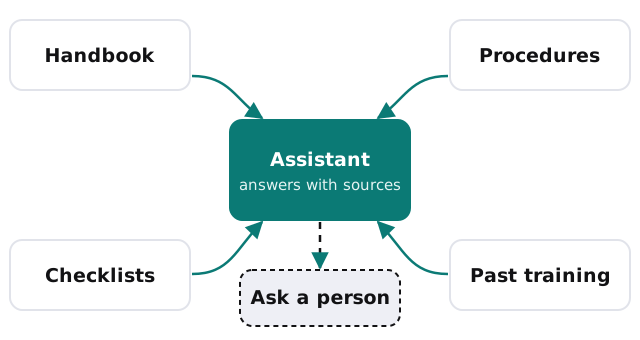
More than a question box
Practice, not just reading
A new hire can ask to be quizzed on the procedure they just read, with short scenarios: “A customer says their order arrived damaged. What do you do first?” The assistant checks the answer against your procedure, and explains the gap if there is one.
Nudges at the right moment
After the third day on the front desk, it might offer the cash-up procedure before the first time they need it. The schedule is something you set, not something it guesses.
A view for the manager
You see which topics people keep asking about, which quizzes people struggle with, and which new hires haven’t touched a required document. It points to where your training material is weak.
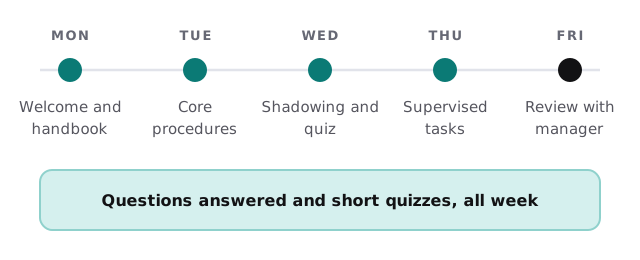
A new hire’s first week
Getting the material ready
- Gather what exists. Handbook, checklists, how-to notes, emails you often forward.
- Mark what’s out of date. The assistant will repeat old advice with total confidence if you let it.
- Fill the obvious gaps. The five things everyone asks and nobody has written down.
- Name an owner for each document. Someone who fixes it when the assistant shows it’s wrong.
- Test it with real questions from your last two hires.
Keeping it honest as things change
Procedures change, and an assistant that quotes last year’s version does more harm than none. Each document has a named owner, a review date and a note of what changed. When a manager updates a procedure, the assistant uses the new text from that point on and can tell staff what changed since they last read it. Without that habit, the tool slowly becomes a confident source of outdated advice.
What it shouldn’t do
- Give opinions on HR disputes, pay or performance.
- Answer from the open web when your documents don’t cover a question.
- Replace sign-offs on safety or compliance training, which need a person and a record.
Rather build it yourself?
For a small team with tidy documents, a general assistant with your handbook loaded can get you started. Our guides to setting up Notion AI and setting up Claude for your team show two ways to do it, and the AI use policy guide covers what staff may put into such tools. We build the version that tracks progress, quizzes people and gives managers a view.
What we need from you
The documents you have, however messy, and a list of the questions new people ask in their first month. A person on your team approves how the assistant answers before any new hire uses it.
The measure of a training assistant isn’t how much it knows. It’s how many interruptions your best people stop getting.