Key takeaways
- Chasing clients for tax documents is paid work that never appears on an engagement letter. Count the chases, the minutes each one takes and your staff hour.
- Tax season is not 50 weeks long. Use your own season length and your own client list, not a yearly average.
- An extension buys time to file, not time to pay, so a missing document can still leave your client with a deadline.
- Hold any reminder tool to one test: a person can read and edit every message before it goes out.
Chasing clients for tax documents is the part of tax season nobody bills for. A client says the return is simple, then the W-2 arrives without the 1099, the brokerage statement is “coming next week” and the mortgage form is somewhere in a drawer. So someone at your firm writes another email.
This post is for the partner who suspects those emails add up. You will count them, put a price on them and see what a late file does to the rest of your season. Then you will see what to ask for before you buy anything to fix it.
What counts as chasing
Chasing is any message you send because a client has not done something they already agreed to do. It is not the first request. It is everything after the first request that gets no answer.
Here is what to look for in your own season:
- A reminder email that repeats the original list.
- A text or call that asks “did you see my email?”
- A second request because the first file was blurry, cropped or the wrong year.
- A staff member opening a folder just to check what has come in so far.
- A partner answering “what do you still need from me?” for the third time.
The last two are easy to miss. Looking up what is missing is work too, and it happens before every reminder you send.
A worksheet for your season
The usual yearly math does not fit here. Tax work is packed into a few months, so use the length of your own season and the clients you actually chase. The example column is made up, to show the format. Fill the last column with your own numbers.
| Line | Example | Yours |
|---|---|---|
| Clients you chase at least once | 120 | |
| Chases per client, all channels | 4 | |
| Minutes per chase, including the lookup | 8 | |
| Hours chasing (120 × 4 × 8 ÷ 60) | 64 | |
| Cost of a staff hour | $40 | |
| Chasing cost for the season (64 × $40) | $2,560 | |
| Returns pushed to extension by missing items | 10 | |
| Extra hours per extended return, to reopen and finish | 2 | |
| Extension cost (10 × 2 × $40) | $800 | |
| Total for the season | $3,360 |
For the hourly figure, you can use your own payroll number. As a reference point, the U.S. Bureau of Labor Statistics says the median pay for accountants and auditors was $83,680 in May 2025 (BLS). Divide that by the 2,080 hours in a full-time year and you get about $40 an hour, before benefits. The example uses that figure.
The worksheet leaves out the hardest cost to price: a partner’s attention. Every chase pulls someone away from preparing a return.
Get your real numbers first
The example above is only a format. Your own figures will differ, so spend two weeks of the season finding out what they are. It costs nothing and it settles the argument in the office about whether chasing is a real problem.
- Pick two ordinary weeks, not the busiest ones.
- Give each person who contacts clients a tally sheet, on paper or in a shared spreadsheet.
- They write one line for every chase: the client, the channel and the minutes it took, including the time spent working out what was missing.
- At the end, add up the minutes and divide the total by the number of clients chased.
- Compare the lines with the due dates. A client who needed four chases and still filed late tells you something different from one who needed one.
Two weeks of honest marks beat any average. If your numbers come out lower than the example, good. You can stop here and spend your money elsewhere. If they come out higher, you now know what a fix has to beat.
The extension is not a clean escape
When documents do not arrive, the usual exit is an extension. That is a legitimate tool. The IRS says an extension of time to file gives a taxpayer until October 15 to file without penalties (IRS).
Read the rest of that page before you tell a client it solves the problem. The IRS says the extension is only for filing the return, and that any tax owed is still due by the April filing date. So a client who is missing a document may still have to estimate and pay on time. That is another conversation your team has to have, and it is one more reason the original chase matters.
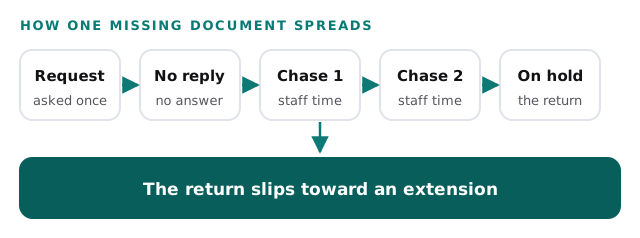
Extensions also move work, not remove it. The return you did not finish in March arrives on your desk in September, when you hoped to be done. Your staff reopen the folder, remember where they stopped and start the review again.
The crunch at the end of the season
The Bureau of Labor Statistics says overtime hours are typical for accountants and auditors at certain times of year, such as during tax season (BLS). Late documents feed that directly. A return that could have been prepared in February is prepared in April, next to everyone else’s.
You can see this in your own files. Pull the date each client’s last document arrived. If the dates cluster in the final weeks, your crunch is partly a collection problem, not a preparation problem. Your team has the same hours all season, but the work arrives late.
Why the usual fix disappoints
Three kinds of fix come up when a firm feels this pain. Each helps, and each leaves something out.
A client portal. A portal gives clients one place to upload. That is a real improvement. But a portal does not make anyone log in. The client still needs a nudge, and someone at your firm still decides who gets it.
A reminder schedule. Automatic reminders on set dates save typing. The risk is the message itself. A reminder that lists everything, or goes to a client who sent the item yesterday, gives clients a reason to skim your emails next time.
Another seasonal hire. An extra person to send follow-ups takes the work off your preparers. It does not shrink the work, and the new person needs to learn your clients before March.
None of these is dishonest. They solve one slice of a problem that has several parts: asking clearly, knowing what is missing and following up at the right moment without losing the personal tone.
What to look for instead
Whatever you choose, test it against how the work really happens at your firm.
| Ask for | Instead of |
|---|---|
| A reminder that names only the items still missing for that client | One list sent to everyone |
| A person reads and can edit every message before it goes | Messages sent with nobody checking |
| One place that shows what has arrived for each client | Folders you have to open one by one |
| A trial on a handful of your real clients | A full rollout at the start of the season |
| A client who can simply reply to an email | A new login the client has to create |
You can read more about the design of this kind of workflow on our page about client document collection for accounting firms, and about the industry on our accounting firms page.
After a season, repeat the worksheet. If the chases per client and the extensions fall, you have your answer. If they do not, the tool was not the fix.
An assistant worth seeing up close
We built an AI executive assistant and operations dashboard. It drafts replies to inbox messages for one-tap approval, and it answers questions about sales, orders and cash. It is a working demo, shown here on sample data.
It doesn’t chase documents. It is still worth a look, for one reason. The part to watch is the approval step. Every draft waits for a person to approve or edit it before it goes anywhere. That is the standard to hold any reminder tool to at your firm, and it is easier to judge on a real screen than in a feature list. The walkthrough shows you the whole thing on sample data, so you can decide whether that kind of control fits the way your partners work.
Behind the scenes
Want a behind-the-scenes walkthrough of a real build?
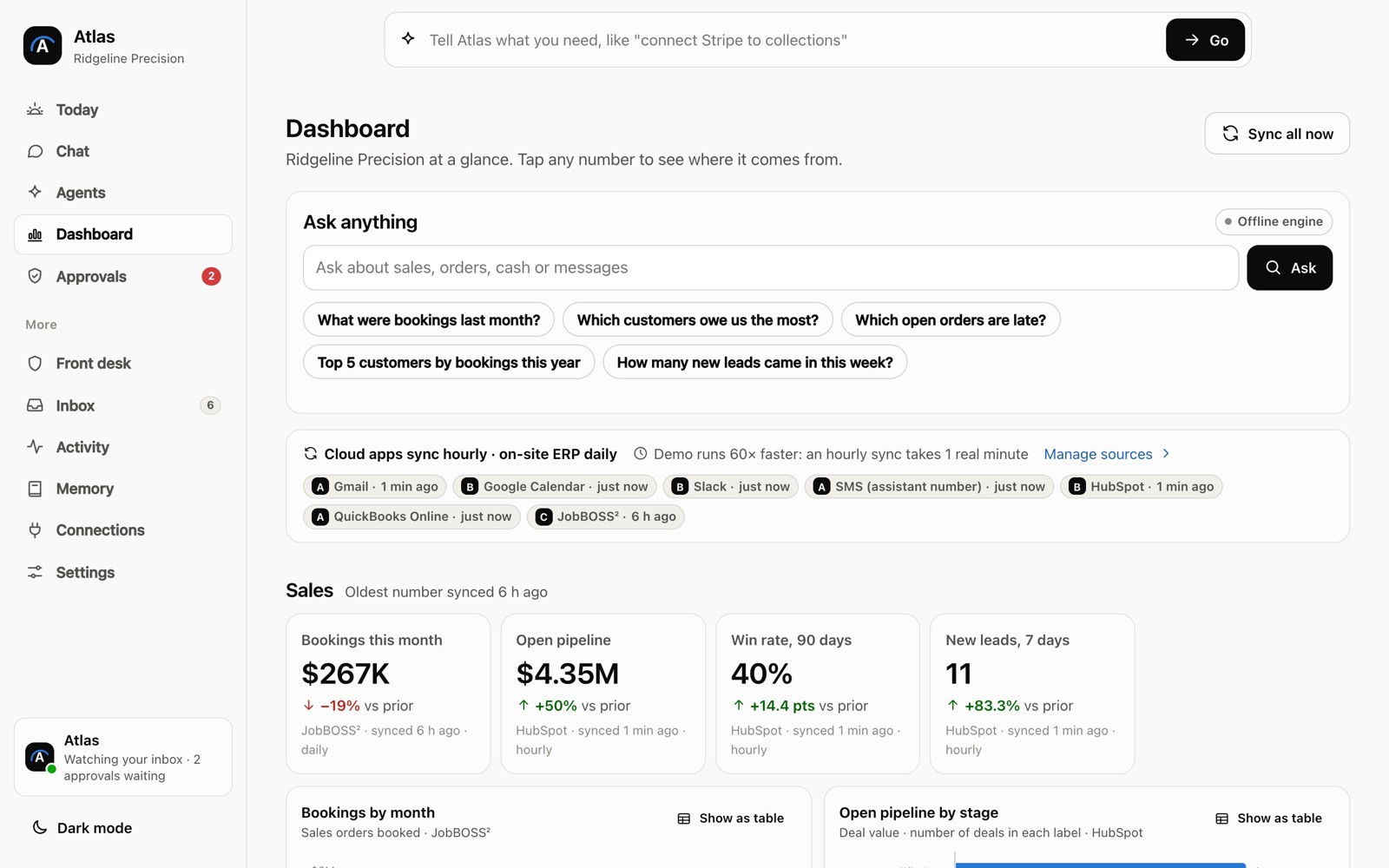
We will take you through it screen by screen: what each person sees, how a record moves through it, and why we built it that way. Then we can talk about the task that costs you most.
Frequently asked questions
How do I count how many hours my firm spends chasing documents?
Keep a plain tally for two weeks of the season. Every time someone sends a reminder, calls about a missing item or re-asks for a file, they make a mark and a rough time. Multiply the two-week total out to the length of your season.
Is putting a client on extension a bad outcome?
Not by itself. The IRS offers an automatic extension to file. The cost is that the work lands outside the peak, and the client still owes any tax by the April date.
Should the same reminder go to every client?
A reminder works best when it names the one or two items still missing for that client. A blanket message makes clients check a list that mostly does not apply to them, and they may set it aside.
Sources
About the author
Andy Kang, AI Partner Team. Andy Kang writes the blog for AI Partner Team, which builds AI tools and internal apps for small businesses alongside managed IT and IT projects. The blog shows the math and the reasoning behind that work, so you can check it against your own business.
- Every fact links to the page it came from, listed under Sources.
- Example numbers are labelled as examples, and you can swap in your own.
- Builds are shown on sample data, with no client names or client figures.