Managed IT services for title companies revolve around money in motion. Escrow accounts hold funds for a short time between a buyer, a seller and a lender, and criminals know it. The IT job is less about clever tools and more about making the careful way the easy way, even on a closing day when everyone is rushing.
One closing, one check
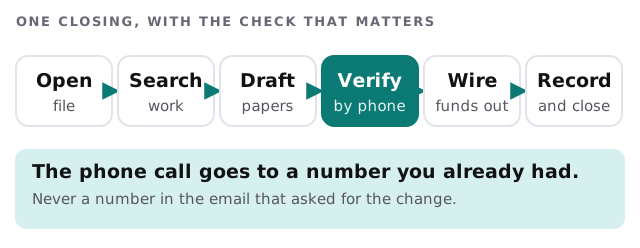
Everything else on the path is routine. The call is where a fake instruction gets caught. Make it a written step, not a good habit, and let any closer pause a wire without asking permission.
How the trick usually arrives
- An email that looks like the agent’s, from an address one letter off.
- A last-minute change to the account number, “because of an audit”.
- Pressure, such as a closing that has to fund before the bank cuts off.
- A thread that was real, until someone’s mailbox was taken over.
A rule that names this kind of work
The FTC’s Safeguards Rule sets out what a covered financial institution must do to protect customer information. Its definition lists real estate settlement services among the activities it covers. Whether it reaches your company depends on what you do, so ask your counsel before assuming either way. Among the measures it describes are:
- Access limited to users who need the information.
- Encryption of customer information in transit and at rest, with approved alternatives where that isn’t feasible.
- Multi-factor sign-in for anyone reaching an information system, unless an equivalent control is approved in writing.
- Secure disposal of customer information within a set time after it is last needed, with exceptions.
- Logging and monitoring of what authorised users do.
We explain these in plain terms and help set them up. We don’t say that your company is compliant, and a rule’s text is not legal advice.
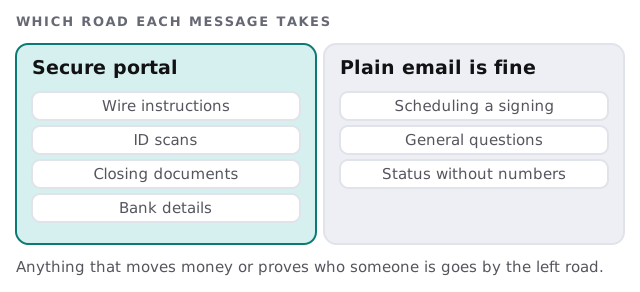
Which road each message takes
Clients send a surprising amount to a title office: driver’s licences, wire details, tax IDs. The safest habit is to decide in advance which messages may travel by plain email.
The day before closing
- Test the printer, the scanner and the signing tools that closers use.
- Check that the portal link works from an outside device.
- Confirm the wire-approval roles, and who covers if one person is out.
- Look at who is out sick or on leave and where their files are.
- Back up the production system, and know where the last backup is.
Closers, processors and the system they share
Title production software holds the file, the commitment, the settlement statement and the funds. Give each closer and processor an individual login, restrict who can release money and review the list of users regularly. A departed processor’s account is a quiet risk, since their emails may still be forwarded to a personal address.
Remote closings and mobile notaries
Signings now happen at kitchen tables, in cars and at a notary’s own laptop. Each one is a small, temporary office. Decide how documents reach the signer and come back, what a mobile notary may keep afterwards and how a package is wiped from a device that isn’t yours. A short written procedure, handed to every outside notary, does more than any tool.
Questions to ask any provider
- How are wire-instruction changes handled, and who approves them?
- Where are IDs and bank details stored, and who can open them?
- What happens to a closer’s access the day they leave?
- How long are files kept, and who decides?
What we need from you
- Your title-production, accounting and portal tools, and who administers each.
- Who may approve a wire, with a named backup.
- How clients send documents today.
Monthly care covers access controls, backups and updates. The free IT check ends in a plan and a fixed quote.
A wire can’t be recalled by a good intention. Make the phone call a step, not a favour.