AI automation for plumbing companies pays off most where plumbing is most annoying: the second trip. A technician arrives, opens the wall, finds a valve that isn’t the one he brought and leaves for the supply house. The customer waits. The next job slides. The day’s margin goes with him.
We build small AI tools and internal tools that reduce those trips and the office work around them. Your team approves what a customer sees.
The second trip
Most second trips come from three causes: a vague description, no photo and nobody comparing what the job probably needs with what the truck carries.
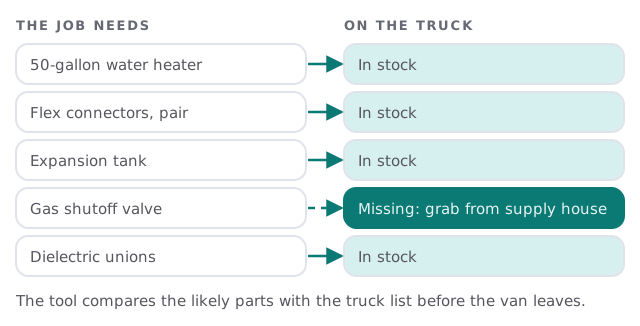
When a booking comes in, a tool reads the description and any photos the customer sent, drafts a likely parts list and checks it against the truck assigned. The dispatcher can then swap the truck, add a stop or tell the tech to pick something up on the way. The tool guesses; the technician confirms on site.
Photos before the van rolls
Ask customers to text a photo of the water heater’s data plate, the leaking fixture or the shutoff. A tool can read the label for brand, model and age, and a drafted note goes onto the job. For a repipe or a sewer problem, the same photos help an estimator decide whether a camera inspection should come first.
Emergency, urgent or routine
| Call type | What the office needs to know | What a tool drafts |
|---|---|---|
| Active leak or no water | Can the customer shut it off? | A message with shutoff steps, flagged for the dispatcher |
| Sewer backup | Single fixture or whole house? | A set of triage questions, answers on the job |
| Water heater | Age, fuel and location | A replacement option list from your price book |
| Drip or slow drain | Photo and how long | A booking offer for a normal slot |
The tool tags answers. It does not decide what counts as an emergency; the dispatcher does.
A map, not a list
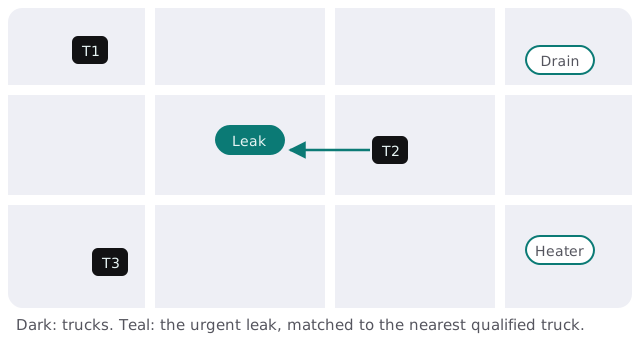
A dispatcher juggling a board of jobs and a dozen texts is making geography and skill decisions in her head. A tool can offer a short list of trucks for a job based on location, on what the tech is licensed and equipped to do, and on how far behind the day already is. She picks.
Winter, holidays and everything between
Plumbing has pressure points that other trades don’t: cold snaps that burst pipes, holiday weekends with full houses and clogged drains, and spring thaw and sprinkler season. A tool can’t predict a freeze, but it can watch the weather forecast you tell it to, draft a note to customers with exposed pipes and prepare your crews’ stock lists a day ahead.
What the technician leaves behind
- A few lines on the phone about what was found and done.
- A drafted invoice description the customer can understand.
- A follow-up, such as a review request after a good job or a photo of the old part.
- A flag if the job suggests another need, like an old water heater at the end of its life.
The software around a plumbing shop
Most shops run field service software for jobs and invoices, a price book, call tracking, accounting and perhaps a maintenance-membership tool. What each lets other tools read varies a lot, which is why we ask before we plan.
Questions to ask any provider
- Does it use my price book, or does it guess prices?
- Who reads the photos, and where are they kept?
- What does a tech see on a phone?
- Who gets the log if a drafted message goes wrong?
What we need from you
A sample of recent job notes and photos, your price book, a list of what each truck carries and the software you use. After the free IT check you get a plan and a fixed quote. A real person replies within 1 business hour, Monday to Friday, 9am to 5pm Pacific. To try a message flow first, draft email replies with Zapier and AI takes an afternoon.
The best repair is the one finished on the first visit. Tools can’t turn the wrench, but they can make sure the wrench shows up with the right fitting.