Key takeaways
- Stock records drift from the shelf one small event at a time: a breakage, a return, a miscount.
- In one large study, 65 percent of nearly 370,000 store inventory records did not match what was there.
- Count 20 items against your records to see your own accuracy before you spend anything.
- A record stays right when every event that moves stock is logged where it happens, by the person who handles it.
The cost of inaccurate inventory rarely arrives as one big bill. It arrives as a staff member walking the back room looking for something the system says you have. It arrives as an order you accepted and then had to cancel, or a supplier you paid extra to deliver tomorrow because the shelf was empty when the record said it wasn’t.
Each of those moments looks like bad luck. Together they are a cost you can measure. This post shows you how to test your own records in an afternoon, price the gap and decide what to do about it.
How the record and the shelf drift apart
Your stock record starts out right. Then things happen to the stock that never make it into the record. A bottle breaks and goes in the bin. A customer returns an item and someone puts it back on the shelf without logging it. An item is sold, but the sale is keyed to a similar product. A delivery is counted in a hurry.
None of those events is large. The trouble is that they add up quietly. Research at MIT on inventory systems found that even a small level of stock loss, built up over time, can make the records inaccurate. That inaccuracy then disrupts reordering and creates out-of-stocks. The same work argued that the sales lost to out-of-stocks can far outweigh the value of the missing items themselves (Kang, MIT).
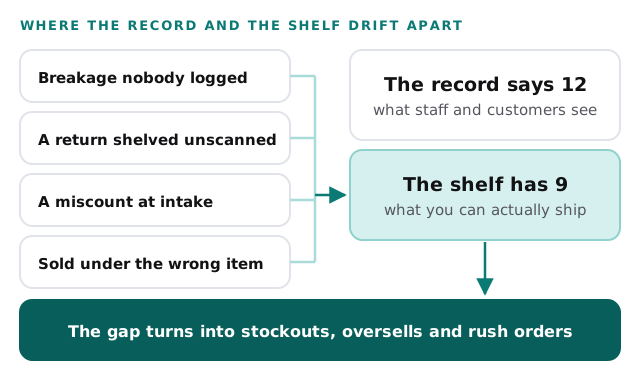
How common is this? A study of one retailer examined nearly 370,000 inventory records from its 37 stores and found 65 percent of them were inaccurate (DeHoratius and Raman). That retailer had systems, staff and procedures. A small business with a spreadsheet and a busy team has fewer of all three.
You don’t need to assume you’re that far off. You can find out.
Run a 20-item count
This takes an hour or two, and it tells you more than any vendor demo will.
- Print or export your current stock list with quantities and locations.
- Pick 20 items at random. Include a few fast sellers, a few slow ones and a few expensive ones.
- Count each item where it is, without looking at the record first.
- Write the count next to the record, and mark whether they match.
- Divide the number of matches by 20. That is your accuracy rate.
Count location as well as quantity. An item that exists but sits somewhere other than where the system says is still a problem, because someone will spend time looking for it.
Here is what a count sheet can look like. These rows are invented to show the format.
| Item | Record says | Shelf has | Match? |
|---|---|---|---|
| Item A, fast seller | 24 | 24 | Yes |
| Item B, slow seller | 6 | 4 | No |
| Item C, high value | 3 | 3 | Yes, wrong shelf |
| Item D, returned often | 10 | 12 | No |
| Item E, seasonal | 0 | 2 | No |
Notice item C. The number matched, but the location didn’t. Decide up front whether that counts as a match. We’d say it doesn’t.
Once you have a rate, look at which items missed. If the misses cluster around items that get returned, the return process is the leak. If they cluster in one location, look at how stock moves in and out of it. If expensive items miss as often as cheap ones, the problem is the process, not carelessness with small things. The pattern tells you where to start, and that matters more than the rate itself.
Put a price on the gap
Accuracy is a percentage. Your bank account deals in dollars. To get from one to the other, count two things.
The first is time. How many hours a week do people spend searching for stock, recounting, fixing records and calling customers about orders you can’t fill? The second is incidents. How many times last year did you sell or promise something you didn’t have, and what did each one cost you in refunds, rush delivery or a lost customer?
Be careful with the incident number. Count orders where you had to apologize, substitute, refund or pay for faster delivery because the stock wasn’t there. Leave out orders that were late for reasons that had nothing to do with stock.
For the hourly cost, use your own payroll numbers if you have them. Otherwise, remember that wages are only part of it. In June 2026, private employers paid an average of $46.89 per hour worked, and only $32.82 of that was wages (BLS). The calculator below starts at $35 to stay cautious.
The starting numbers are made up. Two people spend three hours a week each on stock problems, which is $10,500 a year at $35 an hour over 50 weeks. Eight orders a year go wrong at $150 each, which adds $1,200. That brings the total to $11,700, before counting the customers who quietly stopped ordering.
Why a bigger system doesn’t always help
When stock problems get painful, the usual next step is a full inventory or ERP platform. Some businesses need one. The risk for a small business is paying for far more than it uses while the records keep drifting.
The reason is simple. Software doesn’t count stock. People do, at the moment something moves. If a platform is built for warehouses with scanners at every door, it asks your team to follow a warehouse process. If logging a return takes six screens, the return goes back on the shelf unlogged, exactly as before. Now you also have a subscription and a long setup project.
There’s a second trap. Big platforms are built to fit many businesses at once. If your stock has its own rules, such as items that leave on approval but aren’t sold, or one item that can be priced differently for different customers, the platform may not hold them. Those rules end up in a spreadsheet next to the system. Now there are two records to drift apart.
What keeps records right
Whatever you use, accurate records come from a few habits. The study above found that auditing practices reduce inaccuracy, while complexity increases it (DeHoratius and Raman). In practice, that means making each stock event easy to record and checking a few items often.
| Stock event | How it should get recorded |
|---|---|
| A delivery arrives | Counted against the order, logged on arrival |
| An item is sold | Logged against the exact item, not a close match |
| A return comes back | Logged before it goes back on the shelf |
| Something breaks or goes missing | Logged with a reason, the same day |
| Stock leaves without being sold | Given its own status, so it still shows as yours |
| A few items each week | Counted and compared, so drift is caught early |
When you look at any tool, ask one question for each row. Can the person who handles that event record it in under a minute, where they’re standing? If not, that event will drift.
Inside an inventory system we built
Here’s one we built for a diamond retailer. It’s an inventory system and online catalog. Staff track every stone from intake to memo to sale. Memo is the trade term for a stone that is out on approval with another dealer or a client. It hasn’t been sold, and it still belongs to the retailer while it’s gone. Customers browsing the catalog see the price their own account allows.
That’s the “stock leaves without being sold” row from the table above, built in as its own status instead of a note somewhere. If your stock has rules like that, our page on custom inventory software for jewelry stores goes deeper on how we approach them.
Screens only tell part of the story, though. The useful part is seeing how each stock event is recorded, and why the screens are laid out the way they are.
Behind the scenes
Want a behind-the-scenes walkthrough of a real build?
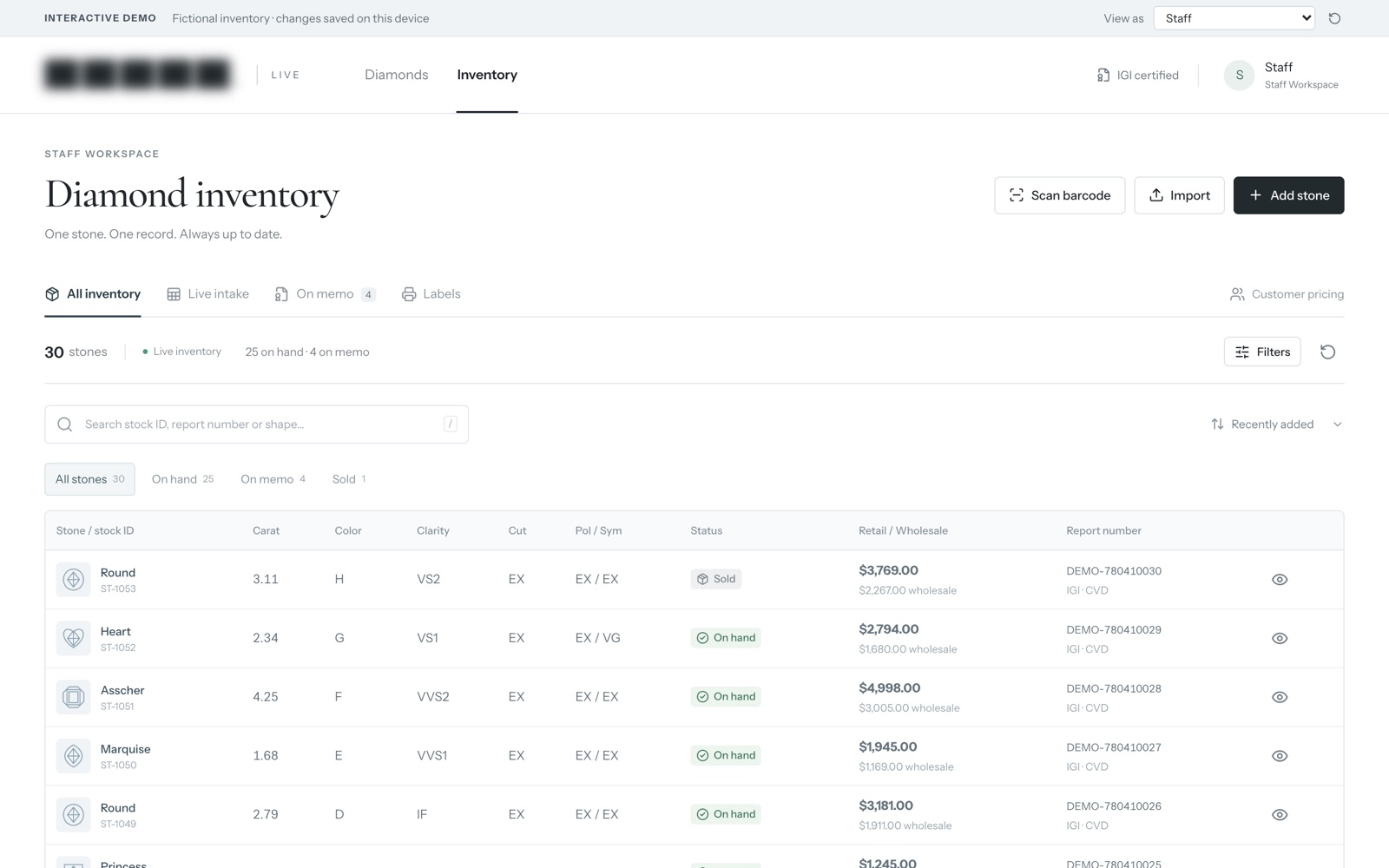
We will take you through it screen by screen: what each person sees, how a record moves through it, and why we built it that way. Then we can talk about the task that costs you most.
Frequently asked questions
How often should a small business count its stock?
Often enough that a mismatch is caught before it reaches a customer. One approach is to count a few items every week instead of everything once a year, so no single count takes long.
What counts as an accurate inventory record?
One where the quantity in your system matches what you can physically find, in the place the system says it is. A record that is right on quantity but wrong on location still costs you search time.
Do we need barcode scanners to keep records accurate?
Not always. Scanners help with high volumes. For a smaller range of items, a simple screen where staff log each change as it happens can do the job, as long as it is quick enough that people actually use it.
Sources
- Inventory Record Inaccuracy: An Empirical Analysis (DeHoratius and Raman, Management Science, 2008)
- Information inaccuracy in inventory systems (Yun Kang, MIT PhD thesis, 2004)
- Compensation costs for private industry workers averaged $46.89 per hour worked in June 2026 (U.S. Bureau of Labor Statistics)
About the author
Andy Kang, AI Partner Team. Andy Kang writes the blog for AI Partner Team, which builds AI tools and internal apps for small businesses alongside managed IT and IT projects. The blog shows the math and the reasoning behind that work, so you can check it against your own business.
- Every fact links to the page it came from, listed under Sources.
- Example numbers are labelled as examples, and you can swap in your own.
- Builds are shown on sample data, with no client names or client figures.