Key takeaways
- Real estate lead response time is a number you can measure this week: the gap between a lead arriving and your first reply.
- NAR's survey of recent buyers found 75 percent interviewed only one agent. A lead who talks to someone else first may never talk to you.
- Price slow leads with your own close rate and your own commission, and treat the result as a ceiling, not a forecast.
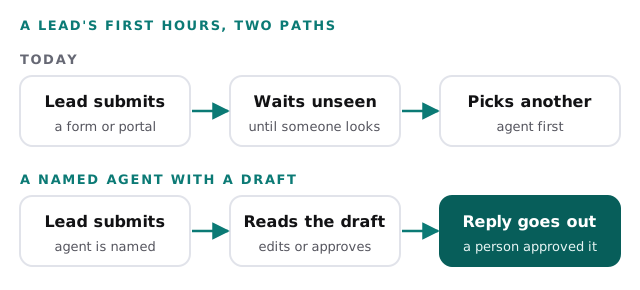
- Look for a setup where each lead has a named agent and a drafted reply, and the agent approves the message before it goes out.
Real estate lead response time is easy to say and hard to see. A buyer fills in a form on a listing at 9 p.m. Your agents are at dinner, at a showing or asleep. The lead sits in an inbox or a portal until someone notices it. By then, the buyer may be talking to another agent.
This post helps you measure the gap in your own office, price it and decide whether it is worth closing. You will not need anyone else’s average. You need your last 20 leads.
What the buyer data says
The National Association of Realtors surveys recent home buyers. Its 2025 generational trends report covers buyers who purchased between July 2023 and June 2024, and it draws on 5,390 responses. In that report, 75 percent of buyers interviewed only one real estate agent, and another 16 percent interviewed two (NAR).
Read that carefully. It does not say the first agent to reply wins. It says buyers do very little comparing. For three buyers in four, the agent they talked to was the only one. If a lead’s one conversation is with someone else, yours never happens.
The same report asked which agent qualities are “very important”. Responsiveness was rated that way by 95 percent of buyers.
It also shows where buyers found their agent. Forty percent were referred by a friend, neighbor or relative, or already knew the agent. Seven percent inquired about a specific property they had viewed online, and 6 percent came through a website with no specific reference (NAR). So online leads are one source among several. How much a slow reply costs you depends on how much of your business starts online, and that is a number in your own lead reports.
What a slow lead looks like inside an office
The lead arrives in one place and the agent works in another. A form feeds a shared inbox. A portal sends a notification email. A text arrives on one agent’s phone. Someone has to see it, decide who gets it and tell that person. Each handoff is a chance for it to wait.
Researchers have studied this in other industries. The authors of a 2011 Harvard Business Review article on online sales leads say that, in their research, most companies are not responding nearly fast enough to online queries (HBR). That article is about companies in general, not real estate, and we are not using it for a number. It is a reminder that the gap is real elsewhere too, so it is worth checking in your office.
Measure your last 20 leads
You do not need software for this. You need a Friday afternoon.
- Pull your last 20 online leads, from your forms, your portals and your inbox.
- For each lead, write down when it arrived.
- Next to it, write down when a person first replied. An automatic receipt does not count.
- Work out the gap for each, in minutes or hours.
- Count how many waited more than a day, or never got a reply.
If your records do not show the times, that is a finding in itself. It means nobody can currently tell you how long your leads wait.
Once you have the gaps, sort them by when each lead arrived: weekday daytime, evenings or weekends. If the slow ones cluster at one time, the problem is coverage at that hour. If they are spread across the week, the problem is the handoff, and more hours of coverage will not fix it.
Price the slow ones
Now turn the count into money. Every number in the Example column is invented. The Yours column is for your own figures.
| Line | Example | Yours |
|---|---|---|
| Online leads a month | 40 | |
| Leads that waited more than a day last month | 10 | |
| Slow leads for the year (10 × 12) | 120 | |
| Your usual close rate on online leads | 1 in 40 | |
| Deals those slow leads would have brought (120 ÷ 40) | 3 | |
| Commission to your office on one closed deal | $9,000 | |
| Value of slow leads for the year (3 × $9,000) | $27,000 | |
| Hours a week spent routing and chasing leads by hand | 3 | |
| Cost of a staff hour (from your payroll) | $30 | |
| Routing time for the year (3 × $30 × 50) | $4,500 | |
| Total for the year | $31,500 |
Be honest about the close-rate line. It assumes a slow lead would have closed at the same rate as the others, and a lead that waited may be less likely to. Use a lower rate if you think so. Treat the total as a ceiling, not a forecast, and expect the real number to be smaller. A smaller number you believe is more useful than a larger one you don’t.
Why the usual fixes fall short
When an office finds a gap, three moves are worth a look. Each one helps and each one leaves something out.
Buying more leads. More leads feels like growth. But if the slow ones are already waiting a day, a bigger pile means more of them wait. You pay for the lead and the delay.
An instant auto-reply. A message that says “thanks, we’ll be in touch” reaches the lead in seconds. It reassures them, and that is worth something. But it does not answer the question they asked, such as whether the house is still available or when they can see it. They are still waiting for a person.
Round-robin routing. Handing each lead to the next agent in line is fair, and it gives every lead a name. The catch is that the next agent in line may be at a showing or out of the office. The lead now has an owner who cannot reply, and nobody else is watching it.
None of these is a bad idea. Each one fixes one handoff and leaves the others.
What to look for instead
A better setup is small. Every lead gets a name and a ready reply, and the agent keeps the conversation.
| Ask for | Instead of |
|---|---|
| Every lead from every source in one place | Leads split across inboxes and portals |
| One named agent per lead, with a backup | A pile that “the team” watches |
| A drafted reply ready for the agent to read | A blank message and a clock |
| The agent approves the reply before it goes out | Messages sent with nobody checking |
| A visible timer on each lead that has not been answered | Finding out at the end of the week |
| Your last 20 leads as the test | A promise about averages |
For the setup itself, see our page on lead follow-up automation for real estate agents. The wider view for brokerages is on our real estate offices page.
Test any change on paper. A month later, take the next 20 leads and run the Friday count again. If fewer waited a day, price the difference with the table above.
An assistant we built, from the inside
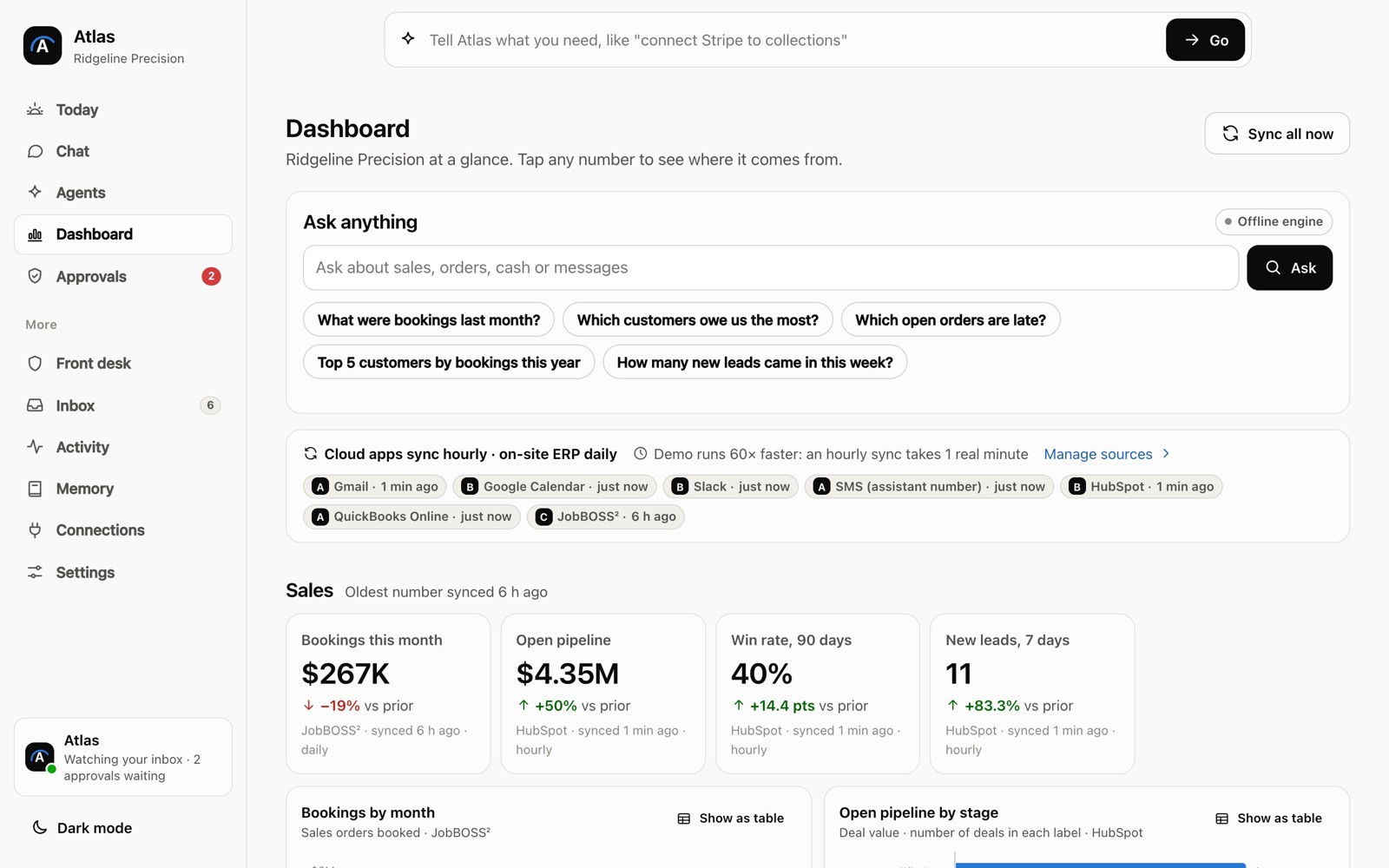
We built an AI executive assistant and operations dashboard. It drafts inbox replies for one-tap approval and answers questions about sales, orders and cash. It runs on sample data.
It isn’t a lead-routing tool. We’re showing it because of what it does with a message. A draft is prepared for a person, and that person decides whether it goes out. That is the part a slow lead needs.
Seeing it up close shows how a draft reaches a person and where the agent steps in.
Behind the scenes
Want a behind-the-scenes walkthrough of a real build?
We will take you through it screen by screen: what each person sees, how a record moves through it, and why we built it that way. Then we can talk about the task that costs you most.
Frequently asked questions
How do I measure how long my leads wait for a first reply?
Take your last 20 online leads. For each one, write down the time the lead arrived and the time of the first human reply. The difference is your response time. Twenty leads is enough to see the pattern, and it costs you an hour.
Do auto-replies count as a response?
For this count, no. An automatic receipt tells the lead the form worked. It does not answer the question they asked, so measure the time to the first message written by a person.
What should a brokerage do with leads that arrive overnight?
Decide the rule before it happens. Who sees the lead first in the morning, and what must they send? Write that down, and check the overnight leads from last week against it.
Sources
About the author
Andy Kang, AI Partner Team. Andy Kang writes the blog for AI Partner Team, which builds AI tools and internal apps for small businesses alongside managed IT and IT projects. The blog shows the math and the reasoning behind that work, so you can check it against your own business.
- Every fact links to the page it came from, listed under Sources.
- Example numbers are labelled as examples, and you can swap in your own.
- Builds are shown on sample data, with no client names or client figures.