Key takeaways
- Slow contractor estimates cost you in two ways: the evening hours spent writing quotes, and the jobs that go to someone else while you do.
- The U.S. Bureau of Labor Statistics describes estimating as collecting data and working out time, money, materials and labor. That is a skilled task, and you are doing it after a full day.
- Yearly cost is the hours a week on quotes, times what an hour is worth, times 50 weeks, plus jobs lost times what each was worth to you.
- Look for a setup where the price comes from one maintained list, not from retyping your notes each time.
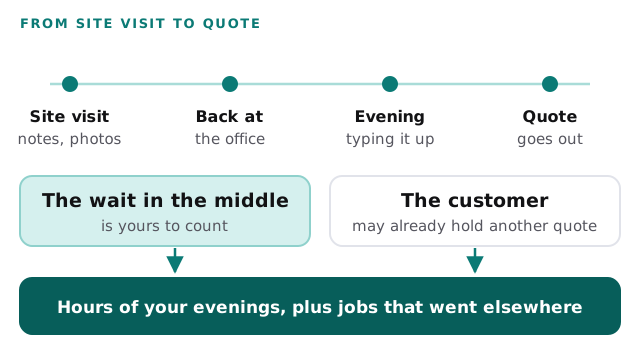
Slow contractor estimates can hide inside a normal week. You visit the site, take notes and a few photos, and tell the customer a quote is coming. Then the next job, the crew and the supplier calls take over, and the quote waits for the evening.
At the kitchen table you read your own handwriting, match photos to rooms, look up prices and type it all into something the customer can read. Below, you will count what that costs: the hours, and the jobs that never came back.
What turning notes into a quote involves
It is worth seeing the task for what it is. The Bureau of Labor Statistics describes cost estimators as people who collect and analyze data to assess the time, money, materials and labor needed to make a product or provide a service. Their listed duties include identifying the factors that affect costs, reading technical documents to prepare estimates, calculating and adjusting figures and keeping records of estimated and actual costs (BLS).
That is the job you take on every time you write a quote. For an employed cost estimator, the BLS reports a median wage of $37.86 an hour in May 2025. That figure excludes self-employed workers, and it is wages only, so it leaves out benefits.
The same page says that accurately estimating costs is vital to the survival of businesses, and that estimators must be precise because small changes may greatly affect the overall expense of a project. Both points hold for you. A rushed quote can lose the job, and a careless one can win a job at a price that loses you money.
Count your own week
You do not need a study for this one. You need two weeks of honest notes.
- Each time you turn site notes or photos into a quote, write down the start and end time.
- Add the time spent on the supporting jobs: finding a price, phoning a supplier, sorting photos.
- Mark each quote with the date of the site visit and the date the quote went out.
- At the end of two weeks, add up the hours and halve them to get a normal week.
Do not skip step three. The gap between the visit and the quote is the number a customer feels, even though you do not.
It also helps to mark which part of each quote took longest: reading your notes, matching photos to rooms, finding prices or laying out the page. After two weeks the slowest part shows you where a fix should start, and it may not be the part you expected.
For the hourly figure, use what an hour of your own time is worth. If you want a reference point, the BLS wage above is one, and the example below uses $38, which is that figure rounded.
Treat these figures as invented, there only to show the layout. The calculator after the table takes your own.
| Line | Example | Yours |
|---|---|---|
| People who write quotes | 2 | |
| Weekly hours each on quotes | 5 | |
| Hours a week in total | 10 | |
| Cost of an hour of that time | $38 | |
| Quote time for the year (10 × $38 × 50) | $19,000 | |
| Jobs a year lost to a slow quote | 6 | |
| What one lost job would have earned you | $1,200 | |
| Lost jobs for the year (6 × $1,200) | $7,200 | |
| Total for the year | $26,200 |
The cost nobody counts: the job that went elsewhere
The evening hours are a steady cost. The lost job is the large one, and you may never hear about it. The customer does not complain. They stop replying.
A 2011 Harvard Business Review article looked at how companies respond to online sales enquiries. Its authors said their research found most companies are not responding “nearly fast enough” (HBR). That article is about online leads in general, not about contractors or quotes, so treat it as a reason to check your own records, not as a number for your trade.
Your records are easy to check. Take the last 20 quotes that never got an answer. Call a few of the customers. Ask whether they went ahead, and with whom. If any of them tell you they had someone else’s quote in hand by the time yours arrived, that is your lost-jobs line. Count them honestly, even if the answer is none. A zero is a useful result too, because it tells you the evening hours are the whole cost and the worksheet’s first half is the one to work on.
Why the usual fixes disappoint
Software and staff both help here. Each one also leaves part of the problem in place, and it is fair to say where.
Estimating software. A good package holds your price lists and does the arithmetic. But the notes from the site still have to be typed in, item by item, so the evening hours are still there. The software has sped up the sum and left the typing.
Quote templates. A template gets you to a clean layout fast. The prices inside it are another matter. When a supplier price changes and the template does not, you are quoting from last year’s numbers, or you are editing each template by hand.
Hiring an estimator. This can take the work off you. It also adds a wage and benefits, and someone has to teach the new person how you price. The BLS wage above is a reference for the cost, and the gap before they are productive is yours to price.
Quoting from memory to go faster. It is quick, and it works until a job is not like the last one. Then the speed costs you in margin.
None of these is a bad purchase. Each of them leaves the notes-to-quote step as manual work. Our page on an AI quote generator for contractors goes into how this kind of tool is built.
What to ask for instead
A better setup keeps your own prices in one place and makes the first draft easy to produce, while you stay in charge of the final number.
| Ask for | Instead of |
|---|---|
| Prices held in one list that you maintain | Prices copied into each quote or template |
| A first draft built from your notes and photos | Starting from a blank page each night |
| You review and change every figure before it goes out | A quote that is sent without you reading it |
| A trial on your own last five jobs | A full switch before you have seen it on your work |
| A record of when each quote went out | No way to see how long the customer waited |
A month on, keep the log for two weeks again. Hours saved, multiplied by your hourly figure and by 50, show what the change is worth. You can also read how we approach trades and contractors.
A price list each customer sees differently
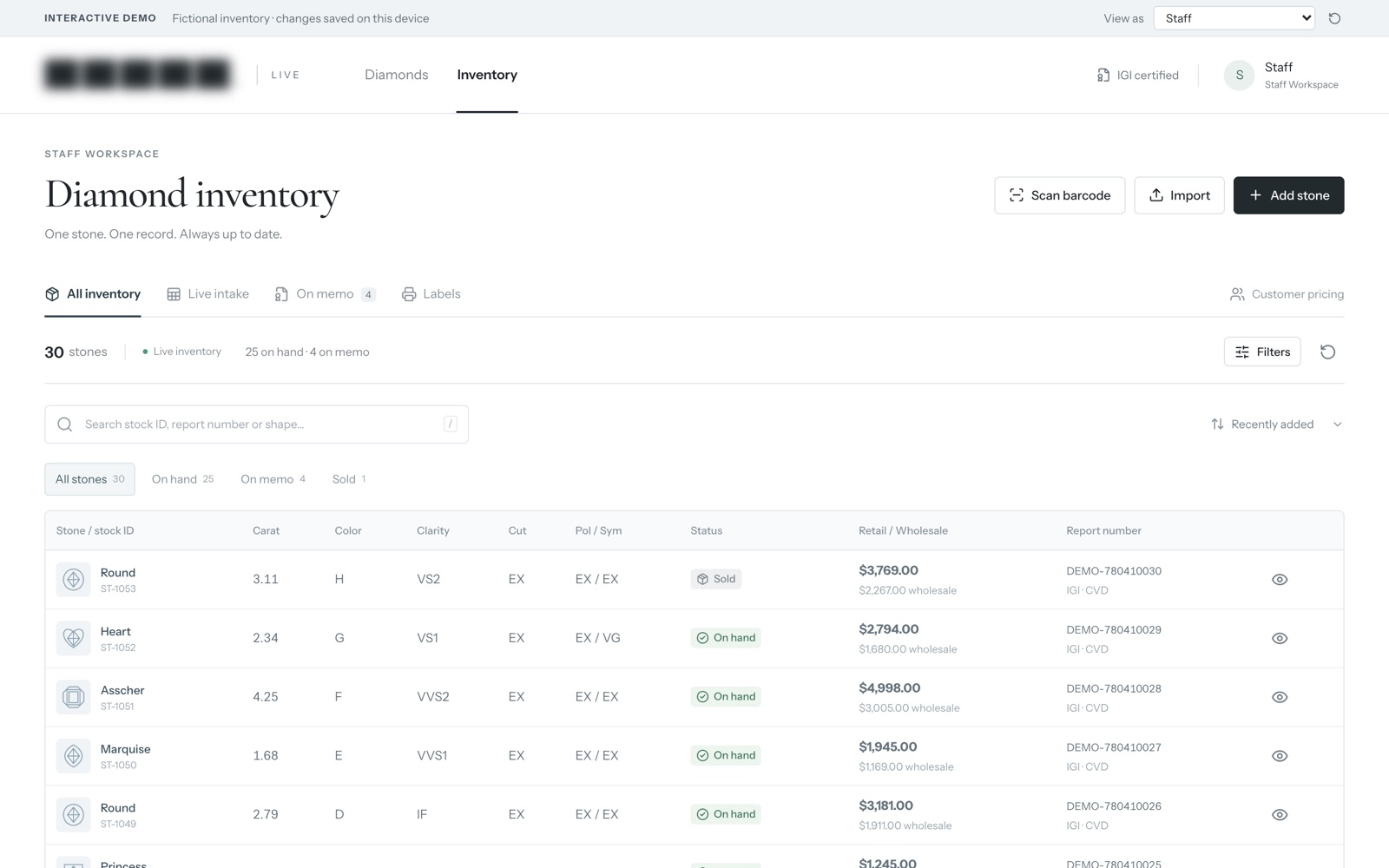
One of our builds is an inventory system with an online catalog, made for a diamond retailer. On the staff side, every stone is tracked from intake through memo to sale. On the customer side, each person sees the price their own account allows. You can see it running on sample data.
A quote needs the same idea. The price a customer sees comes from one maintained record and depends on who is asking, instead of being typed in fresh for each person. It isn’t a quoting tool.
The part to look at closely is how that one record is organised, and how the screens that show a price differ from the screens staff use to keep it current.
Behind the scenes
Want a behind-the-scenes walkthrough of a real build?
We will take you through it screen by screen: what each person sees, how a record moves through it, and why we built it that way. Then we can talk about the task that costs you most.
Frequently asked questions
What should I write down on site so the quote comes together faster?
Note each item of work with its measurements, label each photo with the room or area, and write down what the customer asked for in their own words. Add anything that affects access or time, such as stairs, parking or a locked gate.
How do I find out how many jobs I lost to a slow quote?
Go through the last 20 quotes that got no answer. Call a few and ask what happened. Write down how many say they chose someone else, and what each of those jobs would have earned you.
Should I hire an estimator instead?
It depends on your volume and on how much of the work is routine. Price it with your own numbers: the hours it would save you, the wage and benefits you would pay and the jobs you could keep. The calculator below gives the first half of that sum.
Sources
About the author
Andy Kang, AI Partner Team. Andy Kang writes the blog for AI Partner Team, which builds AI tools and internal apps for small businesses alongside managed IT and IT projects. The blog shows the math and the reasoning behind that work, so you can check it against your own business.
- Every fact links to the page it came from, listed under Sources.
- Example numbers are labelled as examples, and you can swap in your own.
- Builds are shown on sample data, with no client names or client figures.