AI assistant vs virtual assistant sounds like a contest, and owners who treat it as one usually pick on price and regret it. The two are different tools for different kinds of work. One is software that follows rules fast. The other is a person who can use judgment and pick up the phone. Most small businesses have tasks that fit each.
Start with the task, not the label
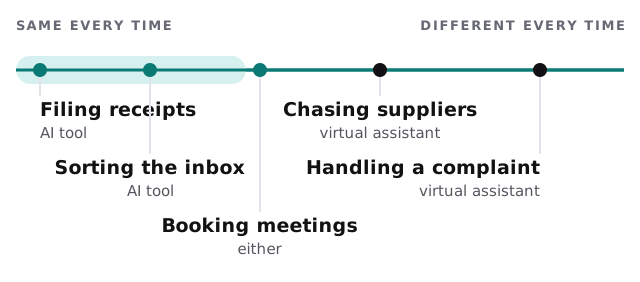
Write down what you’d hand off if you could: ten things, no more. Then place each on a line from “identical every time” to “different every time.” That line does most of the deciding.
What each one is good at
An AI assistant
- Reads and sorts large amounts of written material quickly.
- Drafts first versions of replies, summaries and follow-ups.
- Fills in the same form the same way every time.
- Works through a queue without losing its place.
Its weakness is the unusual case. When something doesn’t match the pattern, a well-built tool stops and hands it to a person instead of guessing.
A virtual assistant
- Makes phone calls and handles voicemail.
- Deals with suppliers, landlords and anyone who needs to hear a human voice.
- Takes on jobs nobody has described yet.
- Notices when something feels wrong and says so.
Its limit is time. A person works a set number of hours, and the tasks that fill them are often the repeatable ones that a tool could do.
Side by side
| Question | AI assistant | Virtual assistant |
|---|---|---|
| New kind of task | Needs setting up first | Figures it out as they go |
| Volume | Handles a lot without strain | Capped by their hours |
| Judgment calls | Flags them | Makes them, within limits |
| Consistency | Same output each time | Varies with the person |
| Onboarding | Rules and connections | Training and trust |
| Who is accountable | You | You |
How owners end up using both
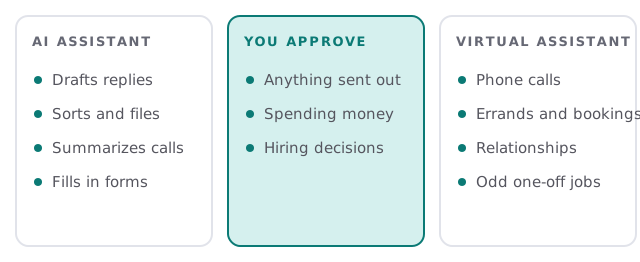
Here’s a typical split. The AI tool sorts the shared inbox into “needs a reply,” “needs a decision” and “can wait,” and drafts replies to the first kind. A virtual assistant works through the second pile, makes the calls and books the appointments. You approve what goes out. Nobody is doing the other’s job badly.
A Wednesday with both
At 8:30 the inbox already has forty messages. Thirty of them are receipts, newsletters and confirmations, and the tool has filed them. Eight are customer questions with a draft answer waiting. Two need a decision, and those sit at the top with a one-line summary each. By nine you’ve approved the drafts. The virtual assistant picks up the two decisions you made, rings the supplier, and moves the booking. Your morning took twenty minutes.
Questions to ask before you pick
- How many of my ten tasks are the same every time? If it’s seven or more, an AI tool probably saves the most.
- Does any task need a voice? Calls and in-person errands still go to a person.
- What happens when it goes wrong? Ask any provider, human or software, for the answer in writing.
- Who sees my data? An assistant with access to your inbox needs a clear list of what it may read and what it may send.
- Who approves? If the answer is “nobody,” start again.
Where we come in
We build AI tools and internal tools for small businesses, with a person approving what they do. We’re not selling you a virtual assistant, and we’ll tell you honestly when your week is better served by hiring one. If you’re weighing the general-purpose options first, choosing an AI assistant for your team compares them without any sales pitch from us.
Hand the AI the work that repeats. Hand a person the work that surprises. Keep the sign-off for yourself.