Key takeaways
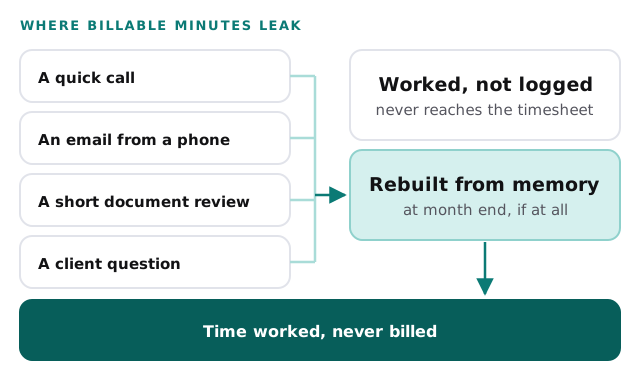
- Lawyers losing billable hours rarely lose a whole afternoon. They lose five-minute calls, short emails and quick reviews that nobody wrote down.
- Price it with your own numbers: minutes unrecorded a day, working days a year, your billing rate and the share you could collect.
- Test the gap for one week by keeping a side log next to your normal timekeeping, then compare the two.
- Look for a way to record time at the moment of the work, in one place, with the partner able to see it.
Lawyers losing billable hours is a problem that does not announce itself. Nobody skips a trial day. What goes missing is smaller: a ten-minute call returned in the car, a short email that answers a client’s question, a quick look at a draft before a meeting. The work was real and the client got value. The time never reached the timesheet.
This post is for the partner who suspects that is happening. You will price it with your own numbers, test it for one week and see what to ask for before you add another tool.
What unrecorded time looks like
Unrecorded time is work a lawyer or paralegal did that has no entry. It is not the same as time the firm chose not to bill. A written-off entry is a decision. A missing entry is an accident.
Look for these in your own firm:
- Phone calls that begin and end between other tasks.
- Emails answered from a phone, away from the desk.
- A short review of a document before a hearing.
- A question a client asks in passing and a lawyer answers on the spot.
- A task done while waiting, with no timer running.
- Time reconstructed at month-end from memory, a calendar and an inbox.
The last item is the one to watch. Reconstruction means that, at some point, a person decided what the week looked like without a record in front of them.
A worksheet with your own numbers
For this one your own numbers matter more than any outside average, so the billing rate is yours to fill in. The example column is made up, to show the format. Fill the last column from your firm.
| Line | Example | Yours |
|---|---|---|
| Minutes of work not recorded, per lawyer per day | 30 | |
| Working days in a year | 230 | |
| Hours a year (30 ÷ 60 × 230) | 115 | |
| Share you could bill and collect | 80% | |
| Billable and collectible hours (115 × 0.8) | 92 | |
| Billing rate | $250 | |
| Value per lawyer a year (92 × $250) | $23,000 | |
| Lawyers in the firm | 3 | |
| Total a year (3 × $23,000) | $69,000 |
Two lines here are guesses: the minutes and the share. Be honest about them, and try a lower number to see whether the answer still matters. If 10 minutes a day is closer to the truth, the same sheet gives you a much smaller figure, and you will know what the problem is worth.
For the staff side, the U.S. Bureau of Labor Statistics says paralegals and legal assistants had a median wage of $30.24 per hour in May 2025 (BLS). The same page lists gathering, organizing and maintaining legal documents among the duties. Their time can slip past the log as easily as a lawyer’s. That figure is pay, not a billing rate. Your own rate is the number to use for the worksheet.
Test the gap in one week
The worksheet needs two honest guesses. You can replace them with a measurement.
- Pick one ordinary week and ask each lawyer to keep a side log. It can be a paper pad or a shared note.
- Every call, email and short task gets a line, with a start time and a rough duration. No judgment about whether it is billable.
- Do not change how time is normally entered that week. You want to compare the two records, not improve one of them.
- At the end of the week, line up the side log against the time actually entered.
- Add up what is in the log and missing from the timesheet. Divide by the number of lawyers and days.
The result is your real minutes a day. It may be small. It may be large. Either way, it replaces a guess with a number you collected yourself.
The Bureau of Labor Statistics notes that most lawyers work full time and some work more than 40 hours a week (BLS). Over a long day, it is worth asking how many small tasks get a line in the log and how many do not.
What to do with your number
Once you have a figure, resist the urge to react to the total. Look at where it comes from.
If the bulk of the gap is phone calls, the fix is about how calls get logged. If it is emails from a phone, the fix is about recording away from a desk. If it is one lawyer and not the others, it may be a habit and not a system problem. Each answer points to a different kind of fix, and the side log tells you which one you have.
Then compare the total with what you would pay to close it. A fix that costs a fraction of the yearly figure is worth a trial. A fix that costs more than the figure has to be better than the estimate, and you should ask why. This is the same arithmetic you would apply to any purchase, only now it uses your own data.
Why the usual fixes disappoint
When a firm sees a gap, a few answers come up. Each one is reasonable, and each one leaves part of the problem alone.
A reminder to fill in timesheets. A weekly nudge helps, and it also points at the weak spot: the entry happens after the work, so the lawyer must remember it. The reminder asks for better memory and does not change when the record is made.
A timer. A start-and-stop timer works for a long task. It works less well for a two-minute call, where starting a timer is more effort than the call. On a short task, the timer is easy to skip.
A stricter policy. Requiring daily entry sets the expectation. It adds a chore to the day of someone already busy, and it does not make the entry easier.
Another billing subscription. A new billing screen can look nicer. If the problem is the moment of recording, a new place to type later does not move that moment.
None of these is wrong. The gap they share is that the record is made after the work, by hand, in a different place from where the work happened.
What to look for instead
| Ask for | Instead of |
|---|---|
| Recording at the moment of the work, in a few taps | An entry typed at the end of the day |
| Short tasks as easy to log as long ones | A timer that suits only long tasks |
| One shared record the partner can review | Notes scattered across phones and notebooks |
| Entries tied to the matter they belong to | A free-text line nobody can sort |
| A trial with two or three lawyers first | A firmwide switch in the middle of a busy month |
You can read more about the idea on our page about a custom time tracking app, and about the field on our law firms page. Billing policy, fee agreements and what the firm may charge are questions for your own counsel and your bar association, not for a software vendor.
After a month on a new setup, repeat the one-week test. If the gap between the side log and the timesheet narrows, it is working.
A shared record, seen up close
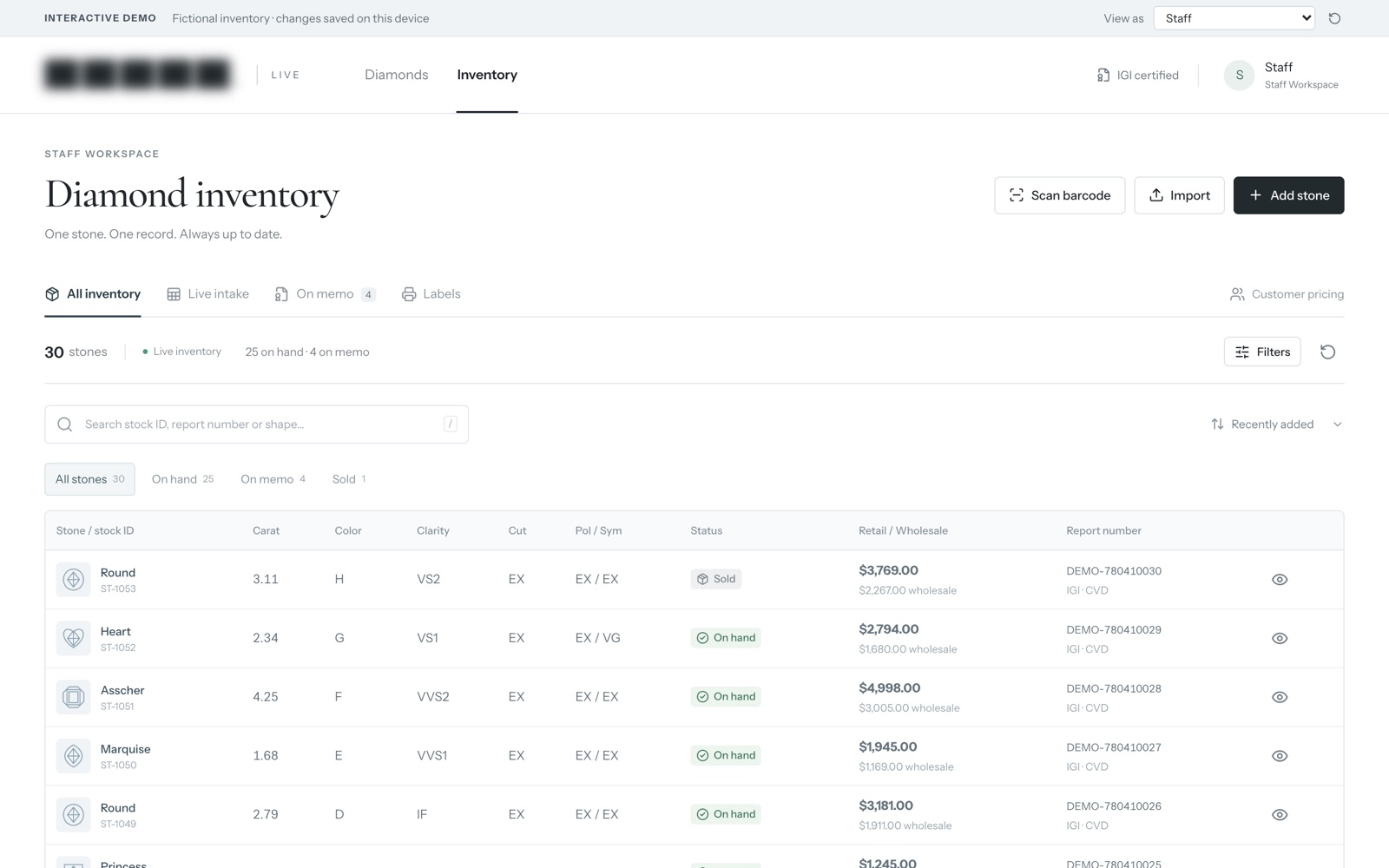
We built an inventory system and online catalog for a diamond retailer. Staff track every stone from intake to memo to sale, and customers see the price their account allows. It is shown here on sample data.
It doesn’t track time. We are showing it because of the idea underneath. It is one shared record that tracks every item through each stage. A time record needs the same shape: one place, every piece of work, each step visible to the people who need it. Seeing how that record is built, and how staff move an item from one stage to the next, shows what that shape looks like in practice.
Behind the scenes
Want a behind-the-scenes walkthrough of a real build?
We will take you through it screen by screen: what each person sees, how a record moves through it, and why we built it that way. Then we can talk about the task that costs you most.
Frequently asked questions
How can I tell how much time my lawyers fail to record?
Have each lawyer keep a plain side log for one week: a line for every call, email and short task, with a rough duration. At the end, compare the side log with the time actually entered for the same week. The gap is your number.
Is reconstructing time at the end of the month a problem?
It depends on how good your notes are. The risk is that a call from the first week is hard to recall by the end, so the entry is skipped or rounded. Check a few reconstructed entries against the calendar and the email trail.
Should the firm bill for every small task?
That is a billing policy for your partners and your fee agreements, and this post does not advise on it. The point here is narrower: whatever your policy is, the time should be recorded so the decision is yours, not an accident.
Sources
About the author
Andy Kang, AI Partner Team. Andy Kang writes the blog for AI Partner Team, which builds AI tools and internal apps for small businesses alongside managed IT and IT projects. The blog shows the math and the reasoning behind that work, so you can check it against your own business.
- Every fact links to the page it came from, listed under Sources.
- Example numbers are labelled as examples, and you can swap in your own.
- Builds are shown on sample data, with no client names or client figures.