You have reached the point where IT questions come up every week, and you are asking whether to hire someone or hand it to an outside provider. Both are legitimate. Hiring an IT person vs outsourcing is easier to decide once you list the jobs.
The jobs a single hire inherits
A job advert says “IT support”. The reality is a bundle of different skills, and one person is asked to be good at all of them.
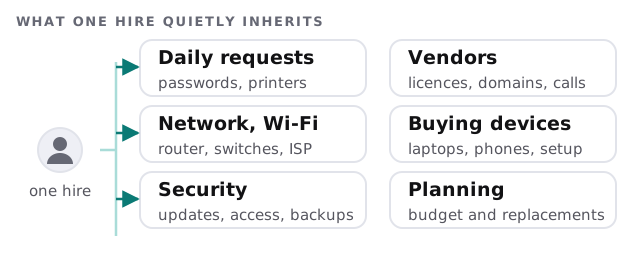
Daily requests are visible, so they get done. Planning and security are not, so they slip. That is not a character flaw. It is how the day works when the printer is down and the owner is waiting.
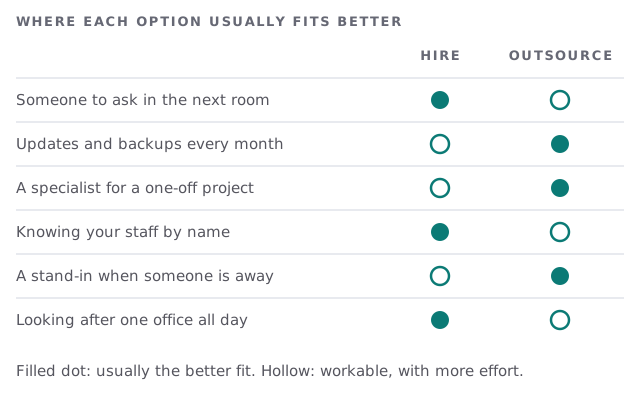
Where each option usually fits better
When hiring makes sense
- People need help in person most of the day.
- Your systems are unusual enough that deep knowledge of them is worth a salary.
- You can offer a real career path, so the person stays.
- There is enough steady work to fill the week.
When outsourcing makes sense
- The workload is real but uneven, with busy weeks and quiet ones.
- You want the monthly care (access controls, backups, updates) done whether anyone remembers or not.
- You want a second set of eyes when you buy, change or decide.
- A stand-in is needed for holidays and sick days.
When you end up with both
A hybrid is common: a person who knows your office, with a provider behind them for projects, security checks and cover. The provider can also hold a copy of the documentation, so the answer to “what happens if they leave?” is already written down.
Two Thursdays in August
With one hire, the person is on holiday and the Wi-Fi fails. The owner phones a cousin who “knows computers”. Nobody knows where the router password is, so the afternoon goes to guessing.
With outside support behind that person, the same Thursday starts with a message. A real person replies within 1 business hour, Monday to Friday, 9am to 5pm Pacific, and the router details are already in the shared notes. The fault is the same. The afternoon is not.
Questions that cut through the sales pitch
Ask the same questions of a candidate and of a provider:
- What happens when you are away for two weeks?
- Where is everything written down, and who else can read it?
- Who holds the admin logins to our email, domain and firewall?
- How will you tell me about a problem before it hurts?
- How do I leave, if I need to?
The answers to three and five tell you more than any price. Whoever you choose, the logins should belong to the company, never to a person.
What a hire changes in the rest of the business
A hire is a manager’s job, too. Someone has to set priorities, approve purchases and notice when the person is overloaded. If your office has no one with time for that, an outside provider takes some of that coordination away, and a fractional lead can do the rest. Our page on a fractional IT director covers that middle path.
If your IT person has already gone, see when your IT person quits for the first week’s checklist. For how paying per incident compares to a standing arrangement, read managed IT versus break-fix.
The question isn’t whether a person or a provider is better. It’s whether the whole list of jobs has a name next to it, and a second name beneath that.
What we need from you
- A rough list of what IT takes up each week, and who does it today.
- Anything already written down about your systems.
- A sense of whether people need help in person or can ask remotely.