A fractional IT director for small business fills a gap that most owners feel but can’t name. Somebody fixes the printer. Somebody else renews the domain. A cousin set up the wifi. Nobody, though, is looking at the whole picture and asking whether any of it makes sense for where the company is going. That’s the job a director does, part-time, so you don’t have to hire one full-time to get it.
What the role decides
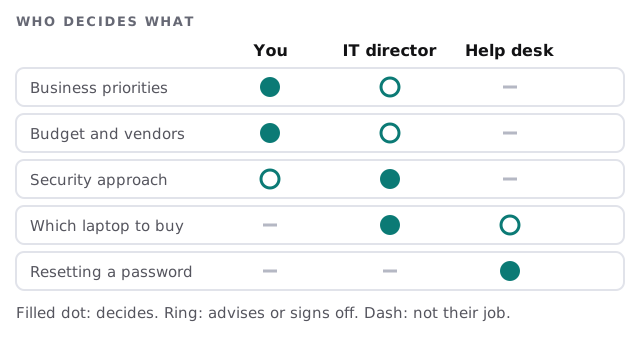
The easiest way to see it is to compare who handles what.
| Question | Owner | IT director | Help desk |
|---|---|---|---|
| What matters most to the business this year? | Decides | Listens | |
| Which vendors do we keep, and which do we drop? | Signs off | Recommends | |
| How much security risk is acceptable? | Signs off | Frames the choice | |
| Which laptop should we standardise on? | Decides | Orders | |
| A staff member can’t sign in | Fixes |
Signs you need one
- Nobody can list every system the company relies on.
- IT decisions get made by whoever is nearest when something breaks.
- You’ve bought the same kind of tool twice.
- A vendor or insurer asked about your security and the answer took a week.
- Your IT person is good, but spends all day on tickets and never gets to the plan.
- You’re about to grow, move or merge, and the technology hasn’t been looked at.
Why governance has its own place
NIST’s Cybersecurity Framework helps organizations understand and improve how they manage cybersecurity risk. Version 2.0 came out on February 26, 2024, and its main addition was a new Govern function, which NIST describes as covering how an organization makes and carries out its cybersecurity strategy decisions. NIST also publishes quick-start guides designed for specific users, small businesses among them.
You don’t need to adopt the framework to take the point. Security and IT aren’t only a set of tools. They’re decisions someone has to own, record and revisit. A director is that someone.
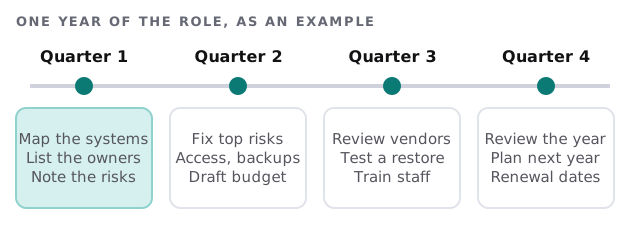
A year of the role
What you’d hold in your hands
- A systems map. Every application, account and device, with an owner for each.
- A risk list in plain English, ranked by how much it would hurt.
- A roadmap for the year, with the next three projects and why they matter.
- A renewals calendar, so licences, domains and certificates don’t lapse unnoticed.
- A short report at an agreed rhythm, written for an owner, not an engineer.
How we’d begin
We start with the free IT check, then produce a plan and a fixed quote for what we’d do first. After that, the work follows the plan: fixing the biggest risks, agreeing the roadmap with you, and being the person your help desk or vendors escalate to. Day-to-day support can come from us, from your existing provider, or from a person on your team, because a director’s job is to make that arrangement work.
Questions to ask any provider
- Who will actually be my director, and will they know my business?
- What will you hand me at the end of the first month?
- How do you work with my existing IT support, not against it?
- If I leave, can I take the documentation with me?
What we need from you
- An hour to talk through where the business is heading.
- Access to the main accounts, in view-only form where possible.
- Whatever exists already: a list of systems, a diagram, last year’s invoices.
- A named person who can make a decision when the director needs one.
IT isn’t short of fixers. It’s usually short of someone who decides what’s worth fixing.