It is 9:12 on a Monday. The front desk cannot print the invoices that go out today, the owner’s phone has stopped getting mail, and the person who usually fixes things is on a client site. That is the moment a help desk for small business is for.
You are not buying a phone number. You are buying a short path from “something is wrong” to “it works again”, with a record of what happened.
What goes in a ticket that gets fixed
The speed of a fix depends less on the technician than on the first message. A request that says “printer broken” starts with questions. One that says who, what, since when and what changed often goes straight to the answer.
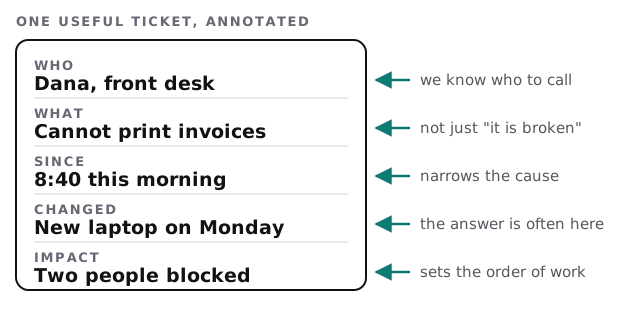
Nobody needs to write like an engineer. Four plain lines work.
The path a request takes
Every ticket follows the same few steps. That sameness is the product. It means you know what happens next without asking.
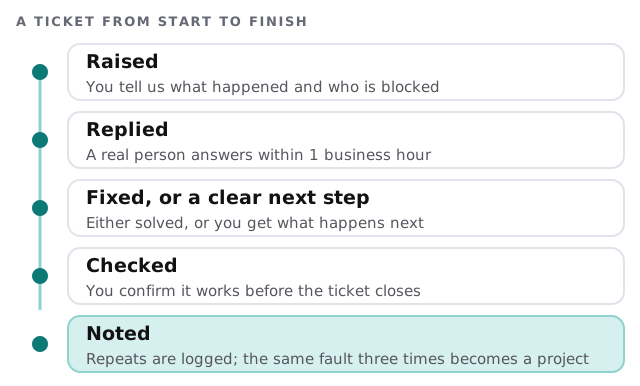
A real person replies within 1 business hour, Monday to Friday, 9am to 5pm Pacific. That reply may be the fix, or it may be a question and a time. Either way you know somebody has it.
Signs you are running on favours
- Requests go to whoever answers fastest, so one person is quietly doing everyone’s IT.
- Nobody can say how many times the printer has been fixed this quarter.
- Fixes live in one person’s head, so a holiday means a delay.
- Staff text each other for help before they ask anyone official.
- The owner hears about a problem only when it has already cost an afternoon.
None of this is a failing in your people. It is what happens when a business grows past the point where goodwill scales. A desk replaces goodwill with a routine.
Ticket or project?
Not every request belongs in the queue. These are the lines we draw.
| It looks like… | It is really… | What happens |
|---|---|---|
| One person’s password | A ticket | Fixed and closed |
| A new starter’s laptop | A small project | Scheduled, with a checklist |
| Wi-Fi drops weekly | A network problem | Investigated at the root, not reset |
| Mail slow for everyone | A service or account issue | Checked against the mail setup first |
| “Can we replace the server?” | A project | Plan and fixed quote first |
Repeat tickets get special treatment. If the same fault shows up three times, we stop closing it and start asking why.
Questions to ask any help desk provider
- How do I raise a request, and will it come back with a reference I can quote?
- Who answers, and is it always someone who has seen our setup?
- What does it cover, and what becomes a separate project?
- Do you tell me when the same problem keeps recurring?
- Do I get a record of what was done, in words I can read?
Where a help desk sits among the other options
If you have one in-house person who is stretched thin, a desk gives them cover and a second pair of eyes. Our notes on managed IT versus break-fix explain the difference between paying per incident and having a standing arrangement. If your IT person has just left, see what to do when your IT person quits.
Rather run your own ticket queue? The guide to setting up Freshdesk for your team walks through the do-it-yourself version. The challenge is not the software; it is having someone who answers every ticket the same week.
A help desk works when asking for help feels cheaper than working around the problem. If staff have stopped asking, the desk has already failed.
What we need from you
- A list of the people, devices and key applications we will be supporting.
- A named contact on your side who can approve a purchase or a change.
- The habit of using one route to ask for help, not three.