Contractors rarely say “we need IT consulting”. They say the estimate was fine but nobody put the change order in the invoice, or that the photos are on four phones. IT consulting for contractors is the habit of finding those leaks on purpose and fixing them in order.
Trace one job
We start with a real project, not a questionnaire. A finished job is best, because the paper trail is complete and nobody is stressed about it.
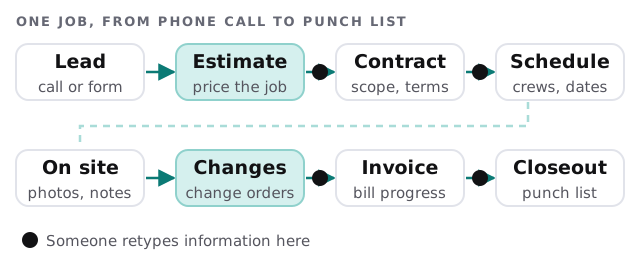
For each handoff we ask three things: who types it, from what, and what happens when it changes. A change order scribbled on a truck seat and entered on Friday is a retype. So is an estimate retyped into a contract.
What we do about each retype
| Where the leak is | Typical cause | A typical fix |
|---|---|---|
| Estimate into contract | Two tools, no link | One entry that feeds both |
| Schedule into field notes | Crew gets a text, office keeps a calendar | One shared schedule, one place for updates |
| Photos and notes | Stored on personal phones | A folder per job, filled from the phone |
| Change order into invoice | Paper, then memory | A change log that the invoice reads from |
| Job costs | Spreadsheet plus accounting software | Costs coded to the job once |
None of these needs a rebuild. Most need a decision about where the truth lives and a habit to match.
What gets fixed first
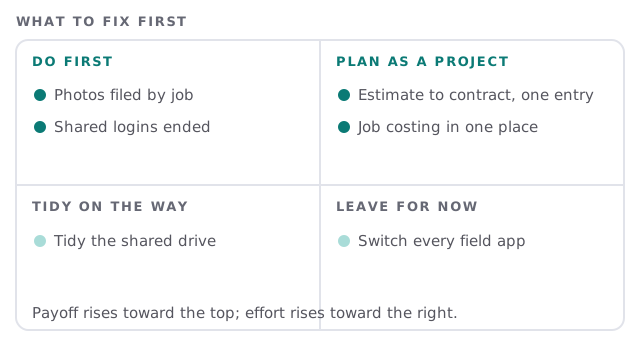
Not every leak is worth plugging this month. We score each by what it would save and what it would take.
Ten minutes with the foreman
The most useful conversation in the whole review is short. We ask what the foreman does with a photo after taking it, where he looks for the latest drawing, and what he does when the office changes something mid-week. The answers are usually blunt: “I text it to myself”, “the one in the truck”, “I find out when I’m on site”. Each answer is a design requirement. None of them appears in a software brochure.
The pressure points in a contractor’s year
Weather, bidding season and year-end all change when a project is safe. A new field app is a poor idea the week before a big pour. A review of access is a good idea in a slow month, when the crew has time to answer questions properly.
If your offices are small, the same person is often estimator, scheduler and bookkeeper. We write recommendations around that reality, so nothing assumes a full-time admin who does not exist.
Who sits at the table
- The owner, who decides what matters.
- Whoever prices jobs.
- Whoever bills them.
- One foreman, who will tell us what the field really does.
Signs it is time
- Two people have different numbers for the same job.
- Nobody can find the final drawings quickly.
- A subcontractor still has access to systems from a job that ended last year.
- The best tool in the business is one person’s spreadsheet.
- The phone is the main record of what was agreed.
Where this leads
A review ends with a plan and a fixed quote for the first project. Sometimes that is a custom internal tool that connects your estimating and invoicing. Sometimes it is a tidy-up of what you own. If quoting speed is the loudest problem, see AI quote generation for contractors. For ongoing care, our notes on managed IT for contractors explain devices, drawings and crews.
A contractor’s IT problem is almost never the technology. It is the same number typed three times by three people who each think theirs is right.
What we need from you
- One finished job and its paperwork.
- A list of the apps your office and crews use today.
- Ten minutes with a foreman.
- Someone with authority to say yes to a first project.